TSA PreCheck for Active Military and Veterans
Active military get TSA PreCheck free using their DoD ID as a KTN. Veterans do not — here's what every service member and vet needs to know about PreCheck access.
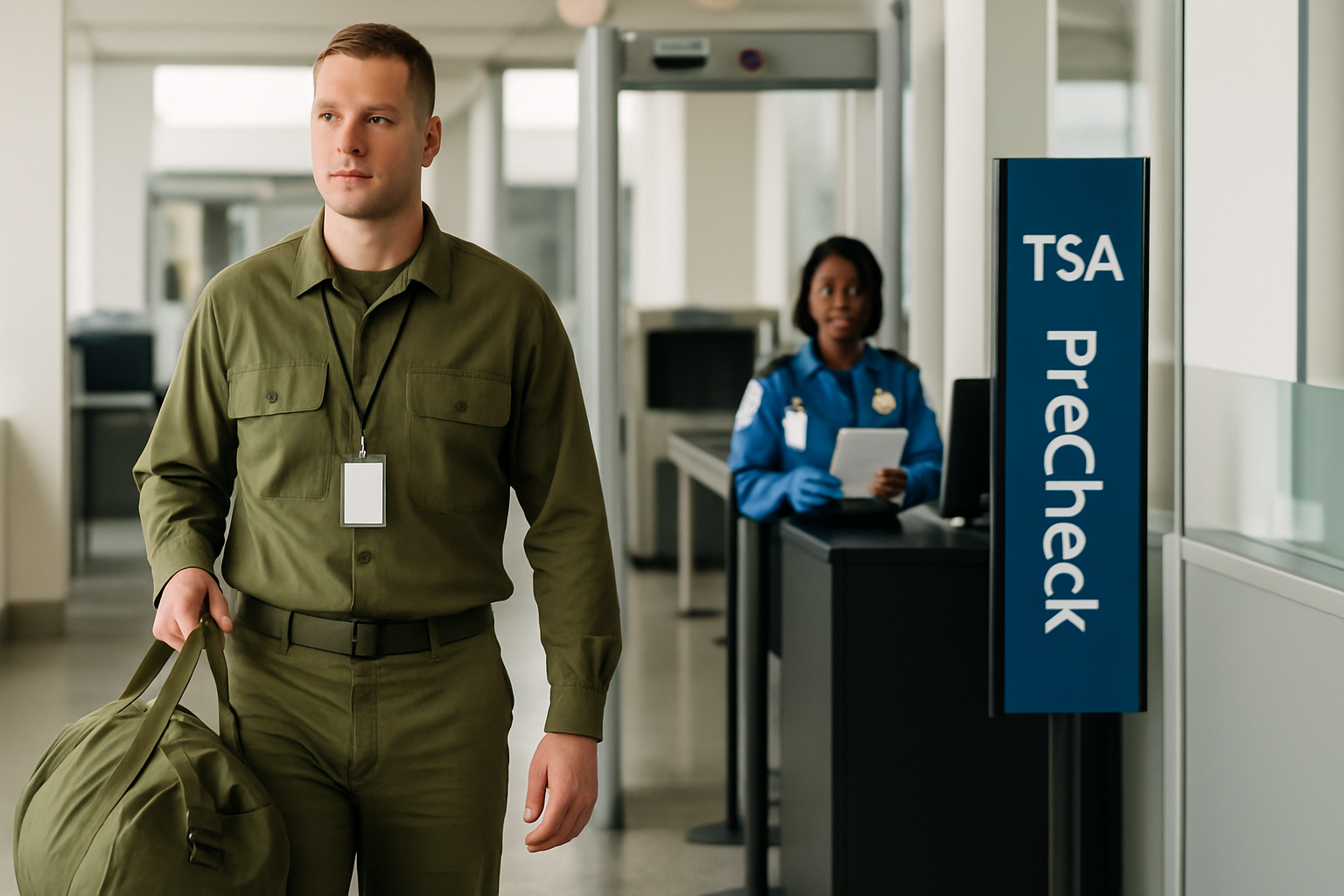
TL;DR
Active-duty U.S. military members get TSA PreCheck free — their DoD ID number functions as a Known Traveler Number (KTN) through the RAPIDS system. Veterans who have separated do not carry that benefit forward. This article explains exactly who qualifies, how to enter your DoD ID at booking, what family members are covered, and what options exist for veterans.
At a glance
- Cost for active duty: $0 — DoD ID number is the KTN
- Cost for veterans: $78 standard enrollment (same as civilians)
- Where to enter KTN: airline booking form, “Known Traveler Number” field
- Family coverage: children 12 and under with enrolled adult — free; spouses need separate enrollment
- Guard/Reserve: free only on active federal orders (Title 10); standard enrollment otherwise
- 100% P&T disabled veterans: may qualify for free Global Entry (includes PreCheck) via VA program
Why this matters
TSA PreCheck is one of the most tangible travel benefits active military receive, yet a large number of service members don’t use it simply because they don’t know the mechanism. There’s no enrollment center visit, no fingerprint appointment, no fee. The DoD ID number that’s already in your wallet is your KTN — you just need to enter it in the right field when booking a flight.
On the other side of the same misconception: veterans often expect the benefit to follow them into civilian life, and it doesn’t. Once your active-duty status ends, the RAPIDS-based vetting no longer applies. Understanding this gap saves frustration at the airport.
How active military PreCheck works
The DoD ID as a Known Traveler Number
Every active-duty service member has a 10-digit DoD Identification Number printed on the back of their Common Access Card (CAC) or Uniformed Services ID. That number is your KTN.
When you enter it on an airline booking, TSA cross-references it against the RAPIDS database — the same system used to issue your ID card. Because RAPIDS already completed a background check when your DoD ID was issued, TSA doesn’t require a separate enrollment appointment or fingerprinting. The vetting is already done.
This applies to all six branches: Army, Navy, Air Force, Marines, Coast Guard, and Space Force.
Entering your DoD ID correctly
The KTN field appears on every major airline’s booking form, typically labeled “Known Traveler Number” or “Trusted Traveler Number.” It also lives in your frequent-flier profile under personal information or travel documents.
A few things to get right:
- Enter the full 10-digit DoD ID number, not your Social Security number or service number.
- The name on your reservation must match your military ID exactly — including middle name or initial if it appears on the ID. A mismatch between the reservation name and your KTN identity can cause PreCheck not to activate.
- If you have an airline loyalty number, save the KTN to that profile so it pre-fills on future bookings.
Once set, look for “TSA PRE✓” on your boarding pass. If it doesn’t appear, the most common cause is a name mismatch.
What PreCheck gets you at the airport
Active-duty members with PreCheck active get the full expedited screening package: no shoes off, no laptop out, no liquids bag out, no belt or light jacket removal. You pass through a standard magnetometer (not a full-body scanner) in the dedicated TSA PreCheck lane.
This is distinct from a military-only lane at some airports. PreCheck is the security benefit; the military ID serves as your boarding ID and identity document at the checkpoint.
What about Guard and Reserve members?
The free PreCheck benefit is tied to active federal service orders, not simply membership in the National Guard or Reserve.
- On Title 10 orders (active federal service): Treated as active-duty — free PreCheck through RAPIDS applies.
- Not on orders: RAPIDS vetting doesn’t activate the benefit automatically. Standard $78 enrollment is the path forward.
If you frequently travel for military duty and aren’t sure of your status, check with your unit’s travel NCO, S1, or equivalent administrative office. Some units have a DoD School Liaison Officer (SLO) who coordinates travel benefits and can clarify what applies to your specific situation.
Veterans: the real picture
Free PreCheck ends at separation
When you leave active service — honorably or otherwise — your RAPIDS-based PreCheck eligibility ends. The DoD ID you received as a retiree or veteran does not carry the same automatic TSA vetting that an active-duty CAC does. You are treated as a civilian applicant.
The standard path for veterans is the same as everyone else: enroll through the TSA Universal Enrollment Center at a cost of $78 for a 5-year membership. Given the number of premium travel credit cards that reimburse this fee (Amex Platinum, Chase Sapphire Reserve, Capital One Venture X, and others), it’s worth checking your card benefits before paying out of pocket. We cover that fully in TSA PreCheck Cost in 2026.
The 100% P&T veteran exception
VA-rated veterans with a permanent and total (P&T) disability rating of 100% have access to a separate benefit. CBP’s partnership with the VA offers these veterans free enrollment in Global Entry — and because Global Entry includes TSA PreCheck, this effectively gives them free PreCheck as well.
As of April 2026, eligible veterans can apply through the CBP Trusted Traveler Programs portal at ttp.cbp.dhs.gov and self-identify as a VA-rated 100% P&T veteran to have the Global Entry fee waived. CBP verifies status with VA records. Confirm current eligibility at va.gov or the CBP portal before applying.
Veterans with ratings below 100% P&T do not qualify for this waiver.
Family members: who’s covered?
Children 12 and under
Children 12 and under traveling on the same reservation as an enrolled adult — including an active-duty military member using their DoD ID as a KTN — get expedited screening for free. No separate enrollment. This is official TSA policy, not a loophole.
Children 13 and older
At 13, children must have their own enrollment to use the PreCheck lane. A dependent ID doesn’t substitute for a KTN.
Spouses and adult family members
TSA PreCheck has no family plan. Each adult needs their own KTN. A military spouse traveling on a separate ticket — or even on the same ticket without their own enrollment — does not automatically get PreCheck.
Military spouses who want PreCheck should enroll through the standard $78 process. Alternatively, some military branches offer travel benefit programs; check with your installation’s Morale, Welfare, and Recreation (MWR) office or your base’s finance office for current options.
Comparing military PreCheck to paid civilian enrollment
| Traveler type | Cost | Process | KTN |
|---|---|---|---|
| Active-duty military | Free | Enter DoD ID at booking — no appointment | DoD ID number |
| Guard/Reserve (on Title 10 orders) | Free | Same as active-duty | DoD ID number |
| Guard/Reserve (not on orders) | $78 | In-person enrollment, fingerprints | Assigned by TSA |
| Military retiree | $78 | In-person enrollment, fingerprints | Assigned by TSA |
| Veteran (honorable discharge) | $78 | In-person enrollment, fingerprints | Assigned by TSA |
| 100% P&T veteran | Free (via Global Entry waiver) | CBP TTP application, interview | Assigned by CBP |
| Military spouse / dependent (adult) | $78 | In-person enrollment, fingerprints | Assigned by TSA |
Common pitfalls
- Entering your SSN instead of your DoD ID. The 10-digit DoD ID is on the back of your CAC or ID card, not the front. It’s distinct from your Social Security number and your service number.
- Name mismatch between reservation and military ID. If your boarding pass name is “John A. Smith” and your DoD ID says “John Albert Smith,” PreCheck may not activate. Keep names consistent across reservations and your KTN profile.
- Assuming retiree ID gives free PreCheck. Retired military receive a different ID card (tan/beige background vs. green for active-duty). That ID does not carry RAPIDS-based PreCheck. Retirees enroll like civilians.
- Depending on family coverage without verifying kids’ ages. Children 12 and under are covered; children 13 and older are not. If your kids are in that range, check their ages before assuming the group gets PreCheck together.
- Skipping the KTN field when booking. Some military members with PreCheck eligibility assume the airline knows their status. The airline has no access to RAPIDS — you must enter the DoD ID in the KTN field on every booking, or save it to your frequent-flier profile.
What to do next
If you’re active duty: find the 10-digit DoD ID number on the back of your CAC, open your airline loyalty account, and save it as your Known Traveler Number. Then enter it on every flight booking. You’re done.
If you’re a veteran: the standard $78 enrollment path through the TSA PreCheck program is your clearest route. If you have a travel credit card, check whether it reimburses the fee before paying. If you’re rated 100% P&T disabled, check the CBP TTP portal for the Global Entry fee waiver.
If you’re a Guard or Reserve member: confirm your current activation status with your unit. If you’re on Title 10 orders, use your DoD ID as a KTN. If not, enroll as a civilian.
egovrush helps travelers — including veterans and military families — navigate the PreCheck and Global Entry enrollment process. Start your TSA PreCheck application and we’ll confirm your eligibility and walk you through every step.
Frequently asked questions
Do active military get TSA PreCheck for free?
Yes. Active-duty U.S. military across all branches get PreCheck at no cost. Their DoD ID number functions as a Known Traveler Number through the RAPIDS database. No enrollment appointment or fee is required.
Do veterans get free TSA PreCheck?
Generally no. Separation from active duty ends the RAPIDS-based PreCheck benefit. Veterans enroll at the standard $78 rate. The exception is VA-rated 100% permanently and totally disabled veterans, who may qualify for a free Global Entry enrollment (which includes PreCheck) through CBP’s VA partnership.
Where do I enter my DoD ID number on an airline booking?
In the “Known Traveler Number” or “Trusted Traveler Number” field during booking, or in the personal information section of your frequent-flier profile. Enter the full 10-digit number from the back of your CAC or Uniformed Services ID.
Can my family members use my free military PreCheck?
Children 12 and under on the same reservation as an enrolled adult get PreCheck for free. Spouses and children 13 and older must enroll individually through the $78 standard process.
Do National Guard members get free PreCheck?
Only when activated on Title 10 (active federal) orders. Guard and Reserve members not on active orders need to enroll through the standard civilian process.
What is RAPIDS and how does it connect to PreCheck?
RAPIDS is the DoD personnel database used to issue military ID cards. When an active-duty member enters their DoD ID as a KTN, TSA verifies eligibility against RAPIDS. Because RAPIDS vetting already occurred when the ID was issued, no separate enrollment is needed.
Sources: TSA PreCheck for military, CBP Trusted Traveler Programs, DHS trusted traveler programs overview.
Want us to handle your TSA PreCheck?
We complete the application and book your enrollment appointment for you.
Related reading
TSA PreCheck costs $78 for 5 years — but credit card reimbursements, military waivers, and enrollment-provider discounts can bring the real cost to $0. Full breakdown.
Renew TSA PreCheck online in about 5 minutes for $70. Step-by-step walkthrough of the TSA UEC dashboard, eligibility window, and what stays the same.
TSA PreCheck vs Global Entry: cost, time, and who each program is for. Plus when getting both makes sense — and how Global Entry includes PreCheck free.
A Known Traveler Number (KTN) is the 9-digit code that unlocks TSA PreCheck on your boarding pass. Here's where to find yours and how to add it to a reservation.