Closed-Loop Cruises: Can You Use a Birth Certificate?
On a closed-loop cruise, U.S. citizens can board with a birth certificate plus photo ID. Here's what qualifies, what doesn't, and why a passport is still smarter.
TL;DR
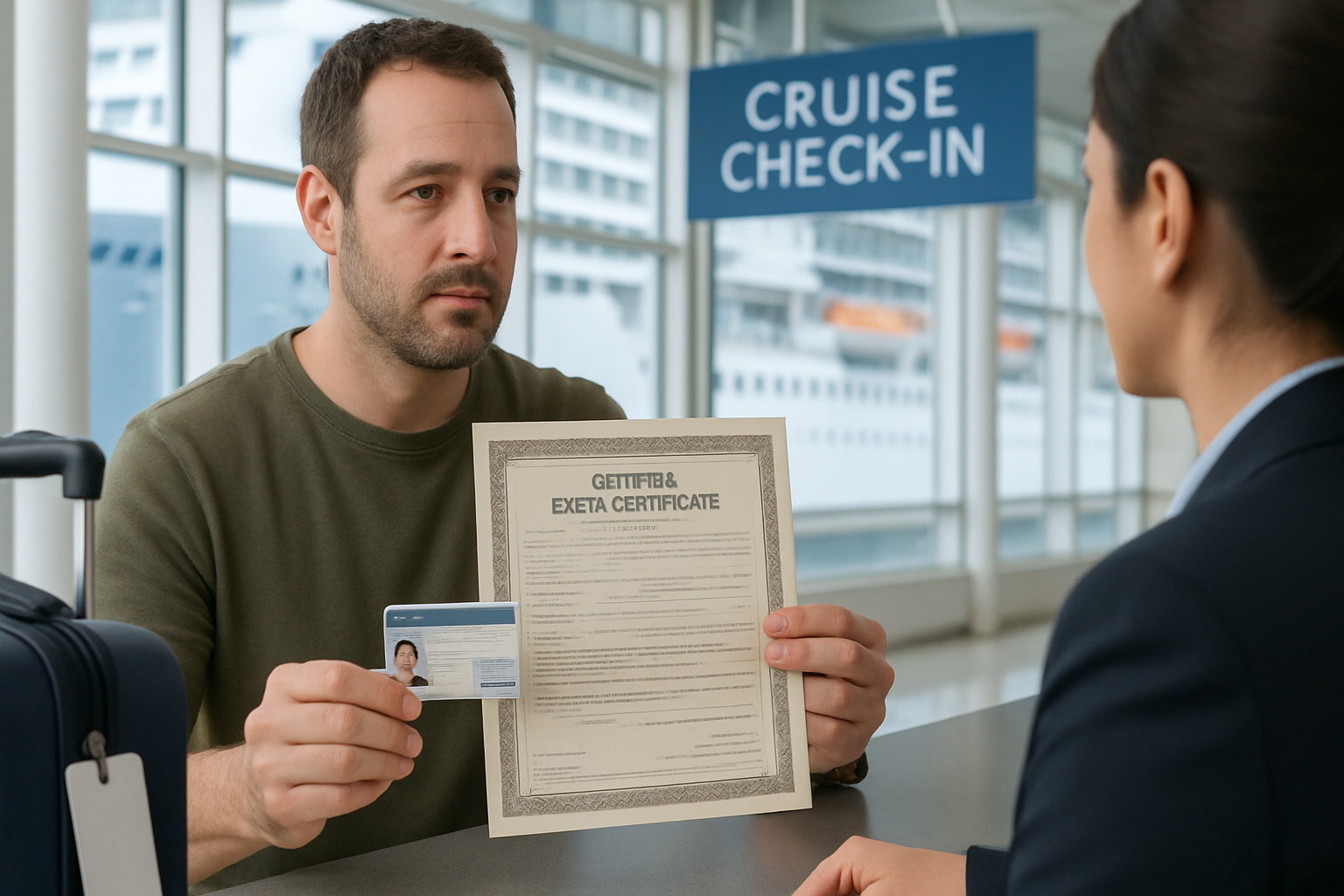
On a closed-loop cruise — one that departs and returns to the same U.S. port — U.S. citizens can board with a certified U.S. birth certificate plus a government-issued photo ID instead of a passport. The law allows it, most major cruise lines accept it, and CBP will honor it at re-entry. That said, a passport book is still the smarter choice for any adult.
At a glance
- Closed-loop definition: departs and returns to the same U.S. port
- Destinations covered: Mexico, Caribbean, Bermuda, Canada (by sea)
- Accepted without a passport: certified birth certificate + government-issued photo ID (adults); certified birth certificate only (children under 16)
- Also accepted: U.S. passport book, U.S. passport card, Merchant Mariner Document, U.S. military ID with orders
- Open-loop cruises: almost always require a passport — check the itinerary carefully
Why this matters
Passport costs and processing times lead a lot of travelers to ask whether they can cruise without one. The honest answer is: yes, on closed-loop itineraries, U.S. law and CBP rules allow it. Section 212(d) of the Immigration and Nationality Act contains the waiver that makes this possible — CBP implemented it to avoid punishing travelers who book a cruise without realizing they need a passport.
But “allowed” and “wise” are different things. Understanding the rule clearly — and its limits — helps you make an informed choice rather than a rushed one.
What “closed-loop” actually means
A cruise is closed-loop when it:
- Departs from a U.S. port (Miami, Port Canaveral, Galveston, Seattle, Baltimore, etc.)
- Visits foreign destinations (Mexico, the Bahamas, Jamaica, Bermuda, Canada, etc.)
- Returns to the same U.S. port it left from
An open-loop cruise starts in one country and ends in another — for example, a repositioning cruise from Fort Lauderdale to Barcelona. Those itineraries generally require a full passport for all passengers.
One common edge case: transcanal cruises that start in Miami and end in Los Angeles are technically open-loop even if both ports are in the U.S., because the ship passes through international waters and the itinerary is one-way. Check the fine print on your booking.
What documents are accepted on a closed-loop cruise
For U.S. citizen adults (16 and older)
You need one of the following:
- U.S. passport book — the standard recommendation; covers all situations
- U.S. passport card — wallet-sized, valid for sea and land crossings, not valid for air travel
- Certified U.S. birth certificate + government-issued photo ID — both documents required together; a photocopy of a birth certificate does not qualify
A certified birth certificate means an official copy issued by the vital records office of the state or county where you were born — the kind with a raised or colored seal. A photocopy, a wallet card copy, or an unofficial printout from a hospital doesn’t count for CBP purposes.
A government-issued photo ID means a current (not expired) driver’s license, state ID, or military ID. It does not need to be REAL ID compliant for cruise purposes — though individual cruise lines may have stricter requirements.
For children under 16
Children under 16 on a closed-loop cruise only need a certified U.S. birth certificate. No photo ID is required. This exemption is specific to closed-loop sea travel — it does not apply to air travel.
If you’re bringing a child and there’s any possibility you’ll need to fly home separately (medical reasons, a family emergency), the child should have a passport too.
What the major cruise lines require
Cruise-line policies must comply with CBP’s minimum requirements but can be stricter. The short version across the major carriers:
Royal Caribbean accepts the birth certificate + photo ID combination on closed-loop itineraries for U.S. citizens. They strongly recommend a passport book and note that it’s required if you fly to a port to join the ship mid-voyage. See their passport requirements page for current specifics.
Carnival Cruise Line follows the same general CBP-based policy for closed-loop sailings — U.S. citizens may use a birth certificate plus photo ID. They also recommend a passport for any passenger whose travel plans might change. Check Carnival’s travel documentation page before booking.
Norwegian Cruise Line (NCL) allows the birth certificate + ID combination on qualifying closed-loop itineraries for U.S. citizens. They note that any travel by air — including getting to the ship — requires a passport. Check NCL’s site directly for their current documentation requirements.
The consistent message across all three: for the cruise itself, the birth certificate + ID combination is accepted on closed-loop itineraries. For flights, you need a passport regardless.
Why we still recommend a passport book
The “allowed without a passport” rule works perfectly — until it doesn’t. Here are the situations where a birth certificate leaves you stuck:
Medical emergency. If you have a serious health event while the ship is docked in Cozumel or Nassau, you may need to be flown to a U.S. hospital. Commercial and air ambulance flights require a valid passport to re-enter the U.S. A birth certificate doesn’t work for air entry under any normal circumstances.
Missed the ship. If you miss re-boarding and the ship leaves without you, you’re in a foreign country needing a flight home. Passport required.
Itinerary change. Ships occasionally divert to ports not on the original itinerary due to weather or mechanical issues. Some alternate ports are in countries with stricter entry requirements than the original destination.
Connecting through an international airport. Even a brief layover in a non-U.S. airport on the way to your embarkation port typically requires a passport.
Future cruises. If you get a passport now, every trip for the next 10 years (adults) or 5 years (children under 16) is covered — cruises, flights, everything.
A passport renewal currently takes 6–8 weeks at routine speed, or as few as a few business days with an emergency appointment. If you’re cruising within the next month and don’t have one, a birth certificate + ID may genuinely be your only option. If you have time, get the passport.
Common pitfalls
- Using a photocopy of your birth certificate. CBP requires a certified original with an official seal. A photocopy, even a very good one, will be rejected.
- Assuming your birth certificate is certified when it isn’t. Hospital-issued “birth records” given to parents at birth are generally not the same as a certified vital record from the state. If your certificate doesn’t have a raised or printed seal from a government vital records office, order a replacement.
- Flying into a foreign port to join the ship. If you fly to meet a closed-loop cruise at a non-U.S. embarkation port, the flight itself requires a passport.
- Expired photo ID. The government-issued photo ID must be current. An expired driver’s license paired with a birth certificate may not satisfy the cruise line’s requirements even if it’s technically the same person.
- Not checking the cruise line’s specific policy. CBP sets the floor. Cruise lines can require more. Always confirm with your specific carrier before sailing.
What to do next
If you’re booked on a closed-loop cruise and have a valid certified birth certificate plus a current photo ID, you’re legally covered for CBP purposes — confirm the same with your cruise line.
If you have any doubt about your documents, or if you’re planning future trips that involve flying, getting a passport resolves everything at once. A passport card is a good middle option: it works for closed-loop cruises and land crossings, costs less than a book, and fits in your wallet.
Start a passport application and we’ll handle the paperwork, photo review, and processing coordination so you’re ready before you board.
Frequently asked questions
What exactly is a closed-loop cruise?
A closed-loop cruise departs from and returns to the same U.S. port. For example, a 7-night cruise from Miami to Nassau and Cozumel that returns to Miami is closed-loop. Open-loop cruises start in one port and end in another — those typically require a passport for all passengers.
Can I use a REAL ID driver’s license instead of a birth certificate on a closed-loop cruise?
No. A REAL ID license alone is not sufficient for a closed-loop cruise. You need a government-issued photo ID (like a driver’s license) plus a certified U.S. birth certificate — or a valid U.S. passport. A REAL ID does not replace the birth certificate requirement.
Do children need a passport for a closed-loop cruise?
Children under 16 traveling on a closed-loop cruise to Mexico, the Caribbean, Bermuda, or Canada only need a certified U.S. birth certificate — no photo ID is required. This exemption applies only to closed-loop cruises, not to air travel.
What if I have a medical emergency and need to fly home mid-cruise?
This is the most important reason to carry a passport even on closed-loop cruises. A medical evacuation flight from a foreign port requires a valid passport to re-enter the U.S. by air. A birth certificate alone won’t get you on a plane home.
Does a passport card work instead of a passport book on a closed-loop cruise?
Yes. A valid U.S. passport card is accepted on closed-loop cruises. Passport cards are wallet-sized, significantly cheaper than a passport book, and work for land and sea crossings with Mexico and Canada. They do not work for international flights.
Do cruise lines check these documents at the port or at the border?
Both. The cruise line verifies your documents at embarkation. CBP or the foreign country’s customs authority checks them when you go ashore at each port. Both sets of rules apply — CBP’s (for re-entry to the U.S.) and the cruise line’s own policy (for boarding).
Sources: CBP Western Hemisphere Travel Initiative — cruise travel, travel.state.gov — U.S. Passports.
Need help with your passport application?
We handle the form, photo check, and tracking. Pay only after eligibility is confirmed.
Related reading
Passport card vs book: the card costs less and fits in your wallet, but only works for land and sea travel. Here's which one you actually need in 2026.
REAL ID enforcement is in full effect at every U.S. airport. If your driver's license isn't compliant, here's exactly what flies and what doesn't in 2026.
Both REAL ID and a U.S. passport work for domestic flights, but they're not equal. Here's when each makes sense and which one you should carry in 2026.