Global Entry vs NEXUS: Which Trusted-Traveler Wins in 2026
Global Entry vs NEXUS: NEXUS costs $50 less, includes Global Entry and PreCheck, but requires Canadian citizenship or residency. Full comparison for 2026.
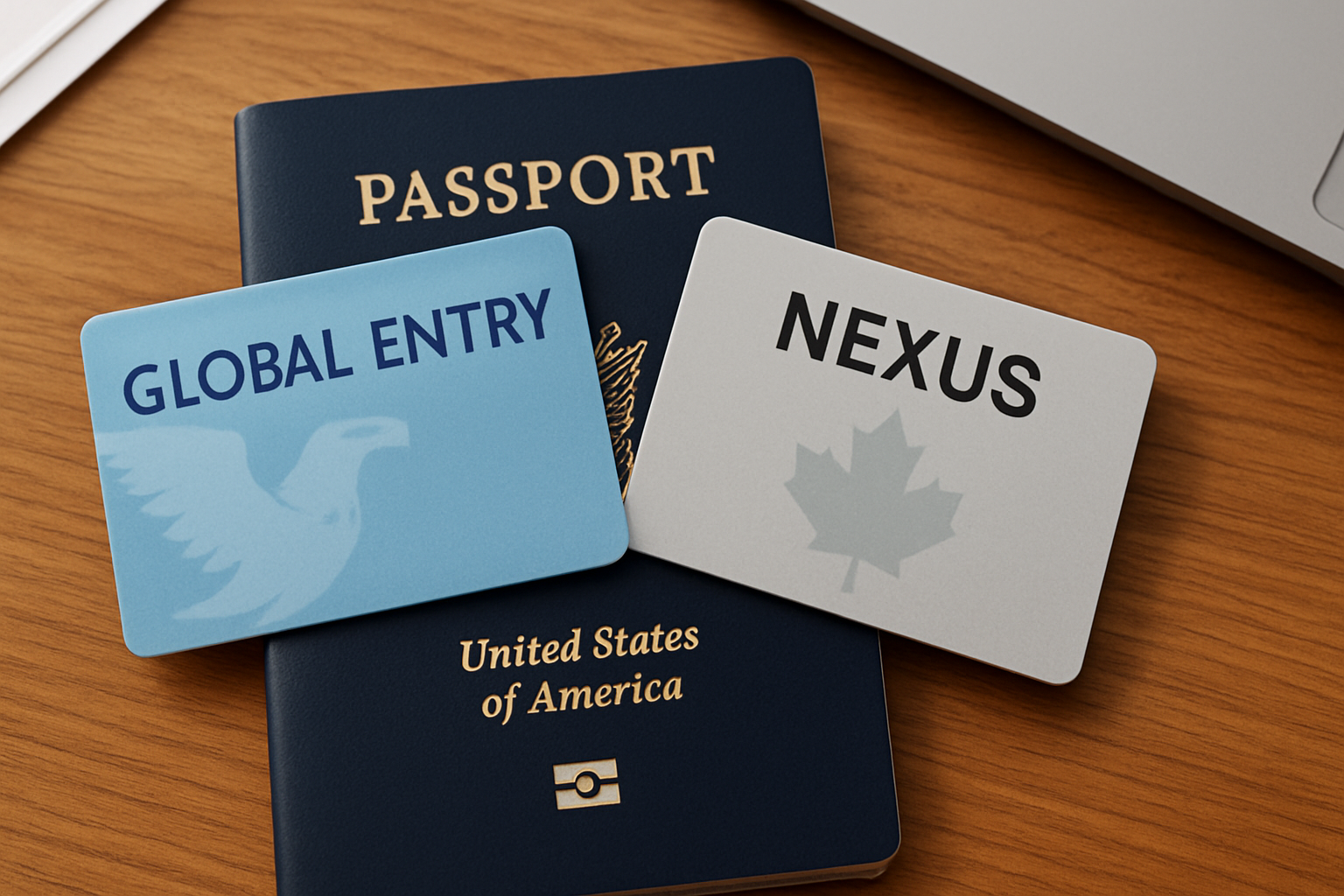
TL;DR
If you’re a U.S. or Canadian citizen who regularly crosses the U.S.-Canada border, NEXUS is the better deal: $50 for 5 years versus $120 for Global Entry, and NEXUS includes Global Entry and TSA PreCheck benefits. If you don’t qualify for NEXUS, Global Entry is the right choice.
At a glance
| Global Entry | NEXUS | |
|---|---|---|
| Price | $120 / 5 years | $50 / 5 years |
| Valid | 5 years | 5 years |
| Eligibility | U.S. citizens, LPRs; select nationalities | U.S. and Canadian citizens/LPRs only |
| Includes PreCheck | Yes | Yes |
| Includes Global Entry kiosks | Yes | Yes |
| Land border benefit | U.S.-Canada and U.S.-Mexico SENTRI/NEXUS lanes | Dedicated U.S.-Canada lanes |
| Interview | U.S. CBP only | Joint U.S. CBP + Canada CBSA |
| Processing time | 2–6 months typical | 3–6 months typical |
Why this matters
The CBP runs four trusted-traveler programs for international travelers: Global Entry, NEXUS, SENTRI, and FAST. Most travelers have heard of Global Entry and maybe NEXUS. The overlap between them confuses a lot of people — including the fact that NEXUS is technically the better deal if you qualify.
Understanding the difference takes about five minutes and can save you $70 over five years.
Global Entry: the baseline for U.S. travelers
Global Entry is the standard trusted-traveler program for U.S. citizens and permanent residents. When you return to the U.S. from abroad, you walk to a CBP Global Entry kiosk, scan your passport and fingerprints, answer a few customs questions on screen, and walk out with a receipt. The process takes under five minutes versus a standard customs wait that can run 45–90 minutes at major hubs.
Global Entry also issues a PASSID that functions as a KTN, activating TSA PreCheck at domestic checkpoints. So one $120 application covers:
- Expedited customs on every international return
- PreCheck security lane on every domestic and outbound flight
The application requires a CBP background check and an in-person interview at a CBP enrollment center or at a Global Entry kiosk on your first international return after conditional approval.
NEXUS: Global Entry’s less-known sibling
NEXUS is run jointly by the U.S. CBP and Canada Border Services Agency (CBSA). It was originally built for people who regularly cross the U.S.-Canada border — they get access to dedicated NEXUS lanes at land crossings and airports on both sides.
What makes NEXUS compelling for American travelers: a NEXUS card number works at U.S. Global Entry kiosks and activates TSA PreCheck. You get the same core benefits as Global Entry at a lower price.
The catch: NEXUS eligibility is limited to U.S. and Canadian citizens and lawful permanent residents of either country. The interview is also more involved — both CBP and CBSA must approve you, and enrollment centers are at ports of entry along the U.S.-Canada border.
The NEXUS value case
At $50 for five years, NEXUS costs $70 less than Global Entry. If you’re a U.S. citizen with no disqualifying history and you live within reasonable distance of a NEXUS enrollment center, the savings are real and the benefits are identical for airport use.
If you also cross into Canada by land — for visits, work, or travel — NEXUS adds dedicated lanes that Global Entry alone does not provide.
SENTRI and FAST: the land-border programs
Two more CBP trusted-traveler programs are worth knowing about for completeness:
SENTRI (Secure Electronic Network for Travelers Rapid Inspection): For frequent travelers crossing the U.S.-Mexico land border. Like NEXUS, it includes Global Entry kiosk access and PreCheck. Cost: $122.25 for 5 years. Requires an in-person CBP interview. Available to citizens and lawful permanent residents of any country (not restricted to U.S./Mexico only). Details at cbp.gov/sentri.
FAST (Free and Secure Trade): For commercial truck drivers moving goods across the U.S.-Canada or U.S.-Mexico border. This is a commercial vehicle program — it does not provide Global Entry kiosk access or PreCheck for personal travel. Most travelers can ignore FAST entirely.
How to choose
| Scenario | Best program |
|---|---|
| U.S. citizen, fly internationally, no Canada/Mexico land crossings | Global Entry |
| U.S. or Canadian citizen, cross U.S.-Canada border regularly | NEXUS (better deal) |
| Frequent traveler on the U.S.-Mexico land border | SENTRI |
| Commercial truck driver crossing borders | FAST |
| Fly domestically only | TSA PreCheck |
Common pitfalls
- Assuming NEXUS is available to everyone. Non-Canadians who are not U.S. citizens or LPRs cannot get NEXUS. Check your eligibility before applying.
- Underestimating NEXUS enrollment center locations. NEXUS interviews happen at ports of entry along the U.S.-Canada border — not at inland CBP enrollment centers. If you’re in Miami or Dallas, the nearest NEXUS center requires a trip to a border crossing. Factor that travel into the cost comparison.
- Not using your NEXUS KTN for PreCheck. A NEXUS card number is a valid KTN. Add it to your airline profiles exactly as you would a Global Entry PASSID.
- Confusing SENTRI with NEXUS. Both include Global Entry benefits, but SENTRI is for the southern border and has different lane access. They are separate memberships.
- Missing NEXUS renewal windows. NEXUS requires both CBP and CBSA to renew your membership. Start the renewal process at least 6 months before expiration.
What to do next
If you’re a U.S. citizen who regularly crosses into Canada and lives near a NEXUS enrollment center, apply for NEXUS and save $70 over five years. For everyone else, Global Entry is the straightforward choice — it covers you at every U.S. customs kiosk and activates PreCheck at domestic checkpoints.
Start your Global Entry application and we’ll walk through the eligibility check, document prep, and interview scheduling with you.
Frequently asked questions
Does NEXUS include Global Entry and TSA PreCheck?
Yes. A NEXUS card number functions as a KTN for PreCheck, and NEXUS card holders can use Global Entry kiosks at U.S. airports. The core airport benefits are identical to Global Entry, at a lower price.
How much does NEXUS cost compared to Global Entry?
NEXUS costs $50 for a 5-year membership. Global Entry costs $120. If you qualify for NEXUS, you get the same airport benefits for $70 less.
Who is eligible for NEXUS?
NEXUS is available to U.S. citizens, U.S. lawful permanent residents, Canadian citizens, and Canadian permanent residents. Citizens of other countries are not eligible.
What is SENTRI and who should consider it?
SENTRI is for frequent travelers crossing the U.S.-Mexico land border. It includes Global Entry kiosk access and PreCheck. Cost is $122.25 for 5 years. Available to citizens and LPRs of any country (not restricted to U.S./Mexico citizens).
What is FAST and how is it different?
FAST is a CBP program for commercial truck drivers crossing land borders. It is not a general traveler program and does not include Global Entry or PreCheck benefits for personal air travel.
Can I use my NEXUS card at a U.S. airport Global Entry kiosk?
Yes. NEXUS card holders can use Global Entry kiosks on return from international travel. Your NEXUS number also activates TSA PreCheck when added to your airline profiles.
Sources: CBP Global Entry program, CBP NEXUS program, CBP SENTRI program.
Want us to handle your Global Entry application?
We complete the CBP form, prep your documents, and book your interview.
Related reading
TSA PreCheck vs Global Entry: cost, time, and who each program is for. Plus when getting both makes sense — and how Global Entry includes PreCheck free.
REAL ID enforcement is in full effect at every U.S. airport. If your driver's license isn't compliant, here's exactly what flies and what doesn't in 2026.
Global Entry, SENTRI, NEXUS, and FAST all speed up border crossings — but they serve different routes and traveler types. Here's how to pick the right one.