Global Entry vs SENTRI vs FAST: Land-Border Programs Compared
Global Entry, SENTRI, NEXUS, and FAST all speed up border crossings — but they serve different routes and traveler types. Here's how to pick the right one.
TL;DR
Global Entry, SENTRI, NEXUS, and FAST are all CBP trusted-traveler programs — but they cover different borders and traveler types. Global Entry is the most versatile for international air travel. SENTRI is for the U.S.-Mexico land border. NEXUS covers the U.S.-Canada border. FAST is for commercial trucking only.
At a glance
- Global Entry: $120 / 5 years — air arrivals from abroad + includes PreCheck
- SENTRI: $122.25 / 5 years — U.S.-Mexico land/sea border + includes PreCheck
- NEXUS: $50 / 5 years — U.S.-Canada border + includes PreCheck
- FAST: $50 / 5 years — commercial truck drivers only, U.S.-Mexico and U.S.-Canada
- All programs: require background check, application via CBP’s Trusted Traveler Programs portal
Why this matters
The U.S. runs four separate expedited-entry programs through CBP, each designed for a specific crossing type. Signing up for the wrong one doesn’t get you the dedicated lane you need. A Global Entry holder who drives across the border every week from Tijuana still waits in the standard vehicle lane. A SENTRI holder who flies internationally still goes through normal customs after landing.
Understanding which program fits your actual travel pattern saves you both money and frustration. It also helps when applying for Global Entry — knowing what you’re paying for and what it covers makes the application decision straightforward.
What each program actually does
Global Entry
Global Entry is CBP’s flagship trusted-traveler program for international air travelers. When you return to the U.S. from abroad, you skip the standard customs line and use a dedicated kiosk at over 75 airports. The kiosk scans your passport or card, takes a fingerprint, and prints a receipt in under two minutes. You hand the receipt to a CBP officer and walk out.
Global Entry includes TSA PreCheck automatically. That means every time you fly domestically (or internationally on a U.S. carrier), you’re eligible for expedited screening. One application gets you both benefits.
Global Entry does not give you a dedicated lane at land or sea border crossings. Those are handled by SENTRI and NEXUS respectively.
SENTRI
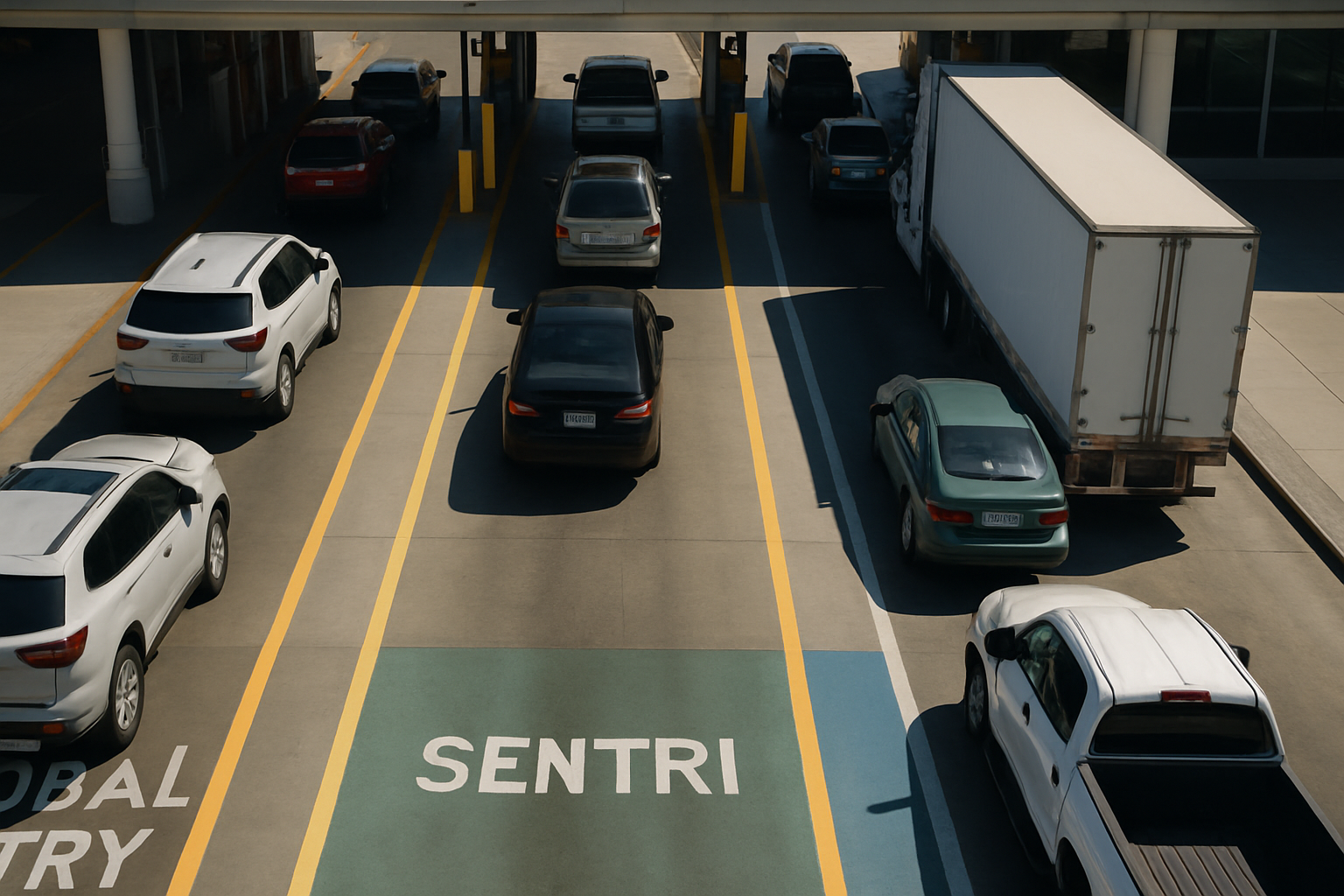
SENTRI (Secure Electronic Network for Travelers Rapid Inspection) is designed for the U.S.-Mexico land border. Approved members get access to dedicated SENTRI vehicle lanes and pedestrian lanes at southern border ports of entry. The lanes move significantly faster than standard traffic — during peak crossing times in cities like San Diego or El Paso, the difference can be one hour versus ten minutes.
SENTRI also includes PreCheck and covers sea crossings at southern ports. Like Global Entry, it requires a CBP background check and an in-person interview at an enrollment center.
If you live in a border community or cross the southern border more than a few times a year, SENTRI is almost certainly worth it. The $122.25 fee works out to about $24 per year.
NEXUS
NEXUS covers the U.S.-Canada border — by land, sea, and air. NEXUS members get dedicated lanes at land crossings, expedited processing through NEXUS kiosks at select airports, and PreCheck. At $50 for five years, it’s the best value in the trusted-traveler suite.
One catch: the interview is conducted jointly by U.S. and Canadian border officers at an enrollment center located at a border crossing. If you don’t live near the northern border, getting to the interview takes planning.
FAST
FAST (Free and Secure Trade) is not for individual travelers. It’s a commercial-trucking program for pre-approved drivers and their registered carrier companies. FAST members get dedicated commercial vehicle lanes at the U.S.-Mexico and U.S.-Canada borders.
If you’re a truck driver or work in cross-border freight logistics, FAST is worth knowing. If you’re a regular leisure or business traveler, this program has nothing to offer you — don’t apply for it expecting airport or passenger-vehicle benefits.
Side-by-side comparison
| Program | Border covered | Crossing type | Includes PreCheck | Fee (5 yrs) | Who it’s for |
|---|---|---|---|---|---|
| Global Entry | International (all) | Air arrivals | Yes | $120 | International air travelers |
| SENTRI | U.S.-Mexico | Land + sea | Yes | $122.25 | Southern border commuters |
| NEXUS | U.S.-Canada | Land + sea + air | Yes | $50 | Northern border travelers |
| FAST | U.S.-Mexico + U.S.-Canada | Commercial truck | No | $50 | Commercial truck drivers |
Note: Global Entry, SENTRI, and NEXUS all require a CBP background check and in-person interview. Fees are verified as of April 2026 — confirm current amounts at ttp.cbp.dhs.gov.
How Global Entry interacts with land-border programs
This is the most common point of confusion. Global Entry does grant access to NEXUS lanes at the U.S.-Canada border — because Global Entry members are considered pre-screened at the same level as NEXUS. That’s an informal benefit CBP extends, but it’s not always documented clearly.
Global Entry does not grant access to SENTRI lanes at the U.S.-Mexico border. Those lanes have their own vehicle transponder system and separate pre-screening. If you have Global Entry and want SENTRI lanes, you need to apply for SENTRI separately.
There’s also no combined application. Each program has its own TTP account application, its own fee, and its own interview. The good news: if you already have Global Entry, your existing background check often speeds up the SENTRI or NEXUS review.
Common pitfalls
- Assuming Global Entry works at the land border. It covers air arrivals. At a land port, you’re in the standard lane unless you have SENTRI or NEXUS.
- Applying for FAST as a non-commercial traveler. FAST is for registered commercial carriers and their drivers only. Your application will be rejected.
- Forgetting that SENTRI covers sea crossings too. If you regularly take ferry crossings at southern ports, SENTRI applies there as well.
- Mixing up NEXUS and Global Entry for U.S.-Canada air crossings. NEXUS has kiosks at select Canadian airports for pre-clearance. Global Entry kiosks are at U.S. airports on arrival. They’re not interchangeable, but NEXUS is often the better value for frequent Canada travelers.
- Letting membership lapse. All four programs expire after five years. Unlike a passport, there’s no grace period — you lose the dedicated-lane benefit the day after expiration.
What to do next
If you primarily fly internationally and want the fastest customs experience at U.S. airports, Global Entry is the right call. It covers air arrivals and bundles PreCheck so your domestic travel gets faster too.
If you also cross the southern border by land frequently, look at SENTRI as a companion enrollment. If you’re near the northern border, NEXUS at $50 is hard to beat.
Ready to apply for Global Entry? Start your application and we’ll walk you through the background check, interview prep, and conditional approval process.
Frequently asked questions
Does Global Entry include SENTRI benefits?
No. Global Entry and SENTRI are separate programs. Global Entry covers air arrivals into the U.S. from abroad. SENTRI covers land and sea crossings at the southern border. If you cross frequently at a U.S.-Mexico port of entry, SENTRI is the program you need — Global Entry alone does not grant you dedicated SENTRI lanes.
Does SENTRI include TSA PreCheck?
Yes. SENTRI membership includes TSA PreCheck, just like Global Entry does. So if you live near the southern border and cross regularly, SENTRI gets you expedited lanes at the border AND PreCheck at the airport.
Can I use FAST if I’m a regular traveler, not a commercial driver?
No. FAST (Free and Secure Trade) is exclusively for pre-approved commercial truck drivers and their registered carriers. It is not available to individual leisure or business travelers.
What if I travel both by air internationally and by land to Mexico?
You would benefit from both Global Entry and SENTRI. They are separate enrollments with separate fees. Some travelers hold both. If budget is a concern, SENTRI includes PreCheck but not Global Entry’s kiosk benefit — so you’d still go through standard customs for air arrivals.
How does NEXUS compare to the others for U.S.-Canada travel?
NEXUS is the dedicated trusted-traveler program for the U.S.-Canada border. It includes PreCheck, expedited lanes at Canadian airports, and NEXUS kiosks at select air and marine ports. At $50 for five years it’s the cheapest option in the trusted-traveler suite.
Is there an interview required for SENTRI or NEXUS?
Yes. Both SENTRI and NEXUS require an in-person interview at a border enrollment center, similar to Global Entry. NEXUS interviews are conducted jointly by U.S. and Canadian officers at a border crossing.
Sources: CBP Trusted Traveler Programs, CBP TTP portal — fees and eligibility.
Want us to handle your Global Entry application?
We complete the CBP form, prep your documents, and book your interview.
Related reading
TSA PreCheck vs Global Entry: cost, time, and who each program is for. Plus when getting both makes sense — and how Global Entry includes PreCheck free.
Global Entry vs NEXUS: NEXUS costs $50 less, includes Global Entry and PreCheck, but requires Canadian citizenship or residency. Full comparison for 2026.
CLEAR speeds up the ID line; TSA PreCheck speeds up the security line. Learn how each works, when to stack both, and how to get CLEAR free via Amex or Delta.