REAL ID Requirements 2026: Documents Every State Accepts
Real ID requirements: proof of identity, SSN, two address proofs, and name-change docs. Bring originals. Here's the full accepted-document list.
TL;DR
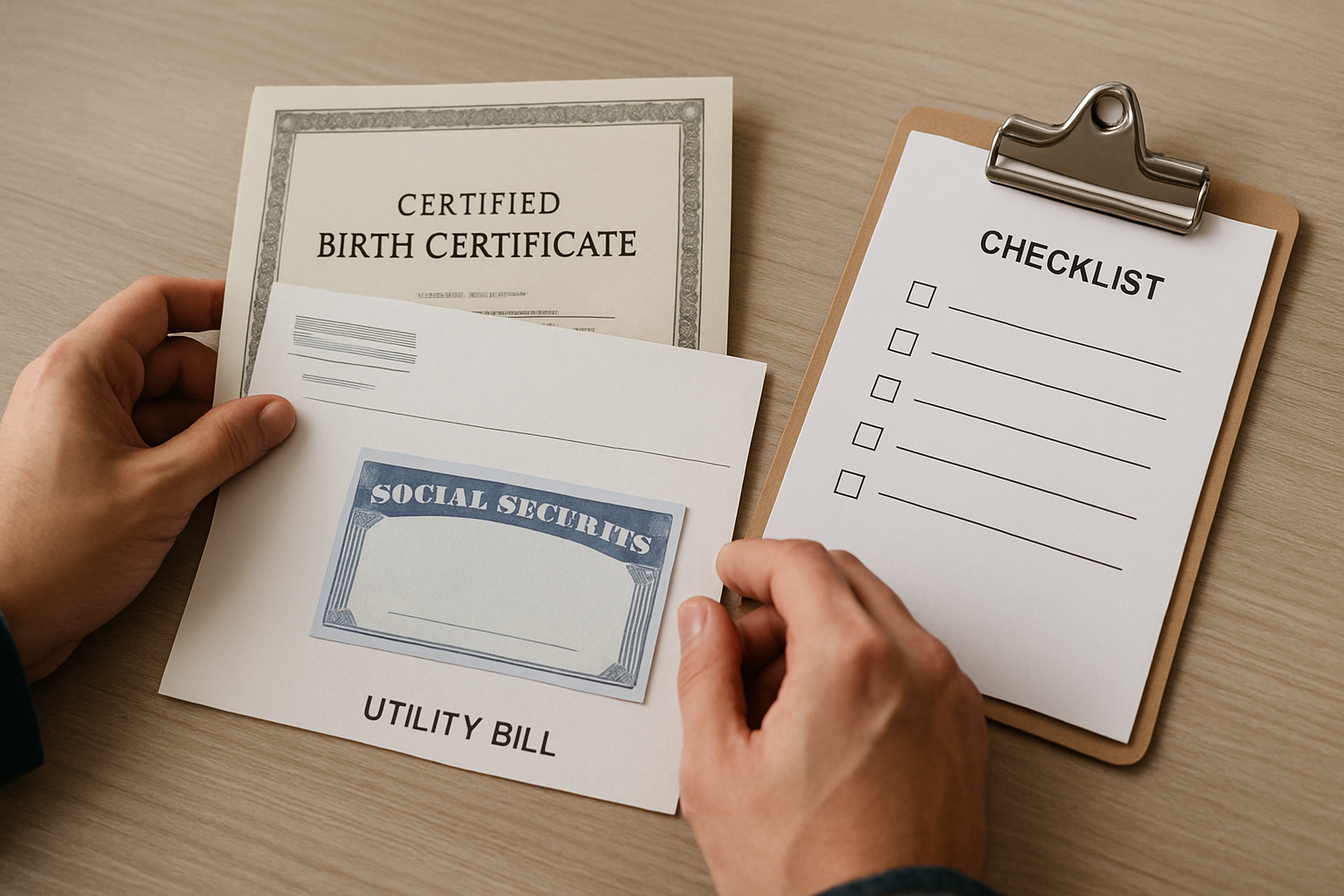
To get a REAL ID at your state DMV, you need proof of identity, proof of your Social Security number, two proofs of your state address, and name-change documents if your legal name has changed. Every document must be an original — photocopies are rejected without exception.
At a glance
- Identity proof: 1 document (birth certificate, U.S. passport, naturalization certificate)
- SSN proof: 1 document (SSN card, W-2, recent pay stub)
- Address proof: 2 documents (utility bills, bank statements, lease)
- Name change: 1+ documents if applicable (marriage cert, court order, divorce decree)
- DMV fee: $25–$50 typical, varies by state
- Appointments: often booked 4–10 weeks out — plan ahead
Why the document list matters
The REAL ID Act set a federal minimum standard for state-issued driver’s licenses and IDs. Before it passed, states had wildly different ID-issuance requirements — some asked for very little. REAL ID forced every state to verify four specific categories of information before issuing a compliant ID.
That verification happens in person, at the DMV, with original documents. You can’t email anything, and you can’t bring a photocopy. This document-gathering step is why millions of people have put off upgrading: it feels like a lot to pull together. In practice, most people can do it in a single afternoon if they know what to look for.
If you already have a valid U.S. passport, you can skip the DMV entirely — a passport book or passport card satisfies the REAL ID requirement at every TSA checkpoint.
The four required document categories
1. Proof of identity
You need one document from this category. It must establish your full legal name and date of birth.
Accepted documents (the most common ones):
- Certified U.S. birth certificate issued by a state vital records office (not a hospital souvenir, not a photocopy). Must have a raised or embossed seal and the registrar’s signature.
- U.S. passport book (current or recently expired — most states accept passports expired within 5 years)
- U.S. passport card (same expiry rule applies)
- U.S. Certificate of Naturalization (Form N-550 or N-570)
- U.S. Certificate of Citizenship (Form N-560 or N-561)
- Permanent Resident Card (Green Card, Form I-551) — for non-citizens
- Employment Authorization Document (EAD, Form I-766) — for non-citizens with work authorization
- Valid foreign passport with I-94 — for certain non-immigrant visa holders
Foreign driver’s licenses and foreign birth certificates are not accepted as identity proof for a REAL ID, regardless of how official they look.
2. Proof of Social Security number
You need one document that shows your full nine-digit Social Security number.
Accepted documents:
- Social Security card (the physical card issued by the SSA — not a number memorized or written on paper)
- W-2 form from any tax year that shows your full SSN
- Pay stub showing your full SSN (last four digits only is not enough)
- SSA-1099 or SSA-1098 form
- Non-SSA 1099 form showing full SSN
Some states also accept a printout from the Social Security Administration’s online portal (ssa.gov), but check your state DMV’s list before relying on that. The SSN card itself is the most reliable option.
3. Two proofs of state address
You need two documents, each showing your name and your current state address. Most states require both documents to show the same address — the address you’ll put on the license.
Documents commonly accepted:
- Current utility bill (electric, gas, water, cable, internet)
- Bank or credit card statement (within the last 60–90 days — check your state’s recency rule)
- Current lease agreement or mortgage statement
- Voter registration card issued by the state
- Vehicle registration card
- Tax documents showing your address (W-2, 1099, recent tax return)
- U.S. federal or state government-issued document showing your name and address
- Pay stub from your employer showing your address
A PO box alone is not acceptable as an address. If you use a PO box, you still need a physical street address.
4. Legal name-change documents (if applicable)
If your current legal name is different from the name that appears on your identity document (situation: you got married, divorced, or had your name changed by court order), you need a chain of documents that bridges every name change.
Accepted name-change documents:
- Marriage certificate (certified copy from the county clerk or vital records)
- Divorce decree that includes a formal name-change order
- Court order for legal name change
- Adoption decree with new legal name
If you’ve changed your name twice (married, divorced, remarried), you may need both documents in sequence to create an unbroken chain from the name on your birth certificate to your current legal name.
State-specific requirements for non-citizens
Federal REAL ID rules require states to verify lawful presence for non-U.S. citizens. In practice this means bringing additional documents:
- Permanent residents (Green Card holders): bring your Permanent Resident Card (Form I-551). Some states also want a foreign passport.
- Valid non-immigrant visa holders: bring your valid foreign passport plus your current I-94 (the electronic version can be printed from cbp.dhs.gov).
- Deferred Action (DACA) recipients: DACA-based EADs are accepted in most states, but a few states have taken different positions under state law. Check your state’s DMV page before going.
- Refugees and asylees: Form I-94 or I-551 stamp in your passport, or a refugee travel document.
The federal baseline is clear, but states have some latitude in exactly which documents they accept from non-citizens. DHS publishes a general guide, but your state DMV’s REAL ID checklist is the definitive source.
REAL IDs for children and minors
Most states do issue REAL ID-compliant IDs to minors (under 18). The document requirements are essentially the same: a certified birth certificate, proof of SSN, and one proof of address — typically a parent’s utility bill or lease, since the minor lives at that address.
Practically speaking, TSA does not require ID for domestic air travelers under 18. So getting a REAL ID for a teenager is more about having a reliable state ID for daily life (school, sports, opening a bank account) than a flying requirement. If your child will need to fly unaccompanied or will turn 18 while on a trip, a U.S. passport covers both the short-term and long-term need.
What doesn’t qualify
A few common documents people assume will work but don’t:
- Photocopies of any document, including certified copies. The DMV officer scans the original. A crisp photocopy of your birth certificate won’t scan correctly for the embedded security features.
- Foreign driver’s licenses — not accepted for identity proof.
- Hospital-issued birth certificates (the souvenir certificate given to parents at the time of birth) — these are not official vital records documents.
- Informal name records — family bibles, baptismal records, school records. These are not government-issued documents.
- Expired foreign passports — your state may accept an expired U.S. passport (within 5 years), but an expired foreign passport is generally not accepted.
What counts as a legal name change
A name change must be backed by a government-issued document. The categories DHS recognizes are:
- Marriage (certified marriage certificate from the county or state)
- Divorce (divorce decree with an explicit name-restoration clause)
- Court order (civil court name change, adopted by a judge)
- Adoption decree (if the name change resulted from adoption)
Note that a Social Security card with your new name is helpful, but it alone doesn’t document the reason for the name change. You still need the underlying legal document. The Social Security Administration updates your card after you file the change with them — it’s a downstream record, not the source.
Common pitfalls
- Bringing photocopies. This is the single most common reason people are sent home. Bring originals only.
- Stale address documents. Many states require utility bills issued within the last 60 or 90 days. A bill from six months ago is often rejected.
- Forgetting the name-change chain. If you’ve changed your name more than once, you need every step documented.
- Missing the SSN card. The SSA card is the most reliable SSN proof. If yours is lost, you can request a replacement at ssa.gov before your appointment.
- Not booking far enough ahead. Most state DMVs are booked 4–10 weeks out for REAL ID appointments. Check availability before you plan your travel.
- Assuming a foreign birth certificate works. It doesn’t. If you were born abroad to U.S. citizen parents, you need a Consular Report of Birth Abroad (CRBA) or your U.S. passport.
What to do next
Pull out all four document categories and verify you have originals in hand before you book the DMV appointment. If you’re missing your birth certificate, see our guide to replacing a lost birth certificate — most states can expedite it in 2–3 business days.
If you’d rather not deal with the DMV at all, a valid U.S. passport satisfies the REAL ID requirement for domestic flights. It also opens up international travel. If yours is expired or you’ve never had one, start your passport application at egovrush and we’ll handle the paperwork.
Frequently asked questions
What documents do I need for a REAL ID?
Four categories: proof of identity (birth certificate, U.S. passport, or naturalization certificate), proof of Social Security number (SSN card or W-2), two proofs of state address (utility bills, bank statements, lease), and legal name-change documents if your name has changed. All originals — no photocopies.
Can I use a passport instead of getting a REAL ID?
Yes. A valid U.S. passport book or passport card satisfies the REAL ID requirement at every TSA checkpoint. You do not need to upgrade your driver’s license.
Does a non-citizen need extra documents for a REAL ID?
Yes. Non-citizens must provide proof of lawful U.S. presence — typically a Green Card, a valid foreign passport with current I-94, or an Employment Authorization Document.
Do children need a REAL ID?
TSA does not require ID for passengers under 18 on domestic flights. Most states do issue REAL ID-compliant IDs to minors using the same document categories, with a parent’s address documents substituting for the child’s.
What if my legal name doesn’t match my identity document?
Bring the legal name-change document that bridges the gap — a marriage certificate, court order, or divorce decree. If your name changed more than once, you need documents covering each change in sequence.
Do I need to renew my REAL ID if it’s not expired?
No. A REAL ID-compliant driver’s license is valid until its printed expiration date. You only need to act if your current license does not display the gold or black star, or if it says “Federal Limits Apply.”
Sources: DHS REAL ID Public FAQs, TSA Accepted Forms of ID. Requirements verified April 2026.
Need help with your passport application?
We handle the form, photo check, and tracking. Pay only after eligibility is confirmed.
Related reading
REAL ID enforcement is in full effect at every U.S. airport. If your driver's license isn't compliant, here's exactly what flies and what doesn't in 2026.
Both REAL ID and a U.S. passport work for domestic flights, but they're not equal. Here's when each makes sense and which one you should carry in 2026.
Proof of citizenship for a U.S. passport: a certified birth certificate works for most people, but 4 other documents are accepted. Here's what the State Dept accepts.
How to get a birth certificate online: order through your state vital records office or an approved third-party service. Costs $15–$50, ships in 4–12 weeks.