What Counts as Proof of Citizenship for a U.S. Passport
Proof of citizenship for a U.S. passport: a certified birth certificate works for most people, but 4 other documents are accepted. Here's what the State Dept accepts.
TL;DR
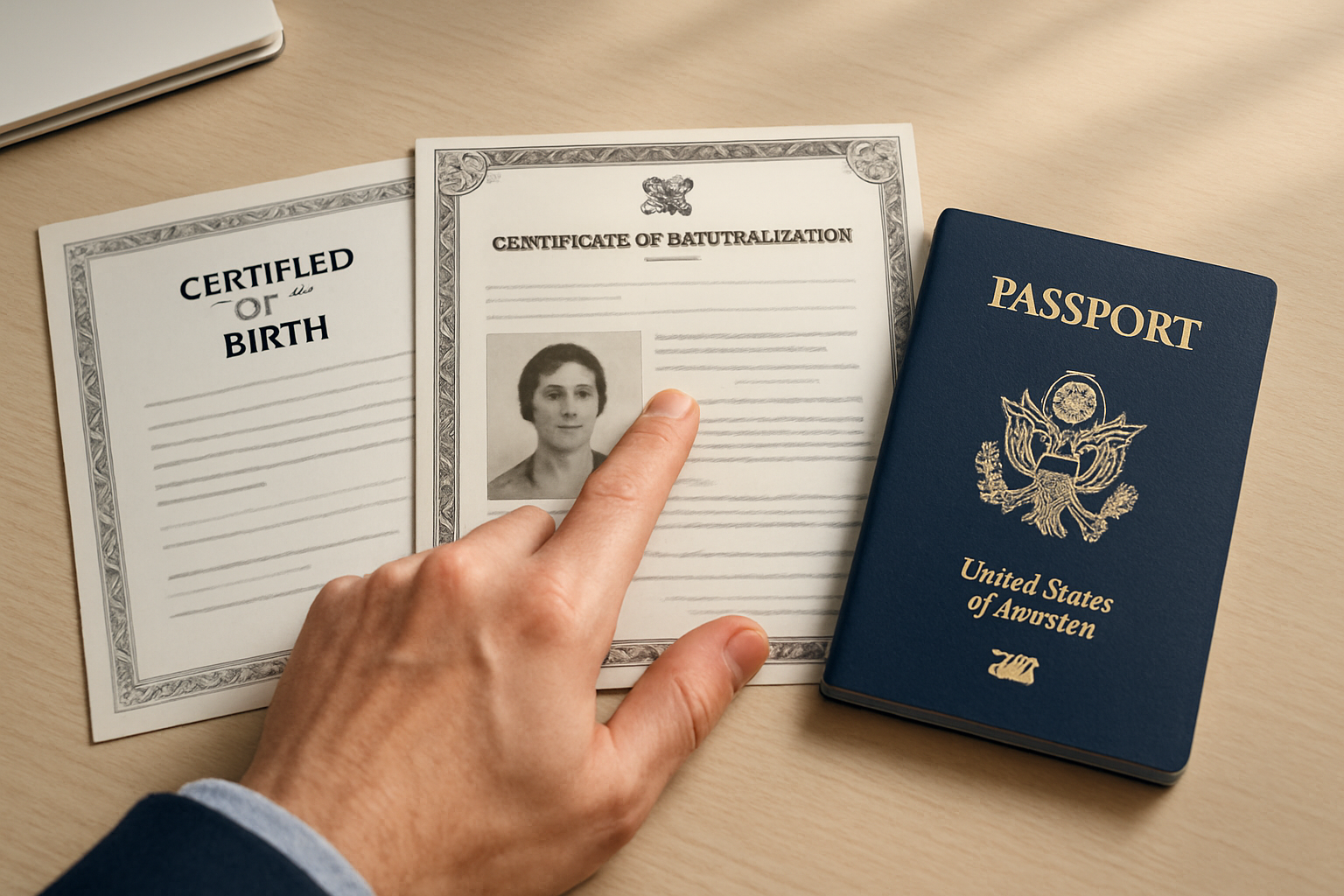
To get a U.S. passport, you need proof of citizenship. For most people, that means a certified birth certificate from the state where you were born. There are four other accepted documents if a birth certificate isn’t available. None of them are photocopies — you need original or certified versions.
At a glance
- Most common: Certified U.S. birth certificate (issued by state vital records)
- Other accepted docs: CRBA, Certificate of Naturalization, Certificate of Citizenship, previous U.S. passport (issued at 16+, less than 15 years old)
- What doesn’t work: hospital birth records, photocopies, expired naturalization certificates
- If you don’t have one: order from your state vital records office; secondary evidence accepted in rare cases
- Fee to order a replacement birth cert: $10–$30 typical, varies by state
Why the State Department requires this
A U.S. passport is only issued to U.S. citizens. Proof of citizenship is how the State Department verifies that status before issuing the document. This is different from proof of identity (a driver’s license or other ID) — you need both for a new passport application.
Every first-time applicant files form DS-11 and must bring both proof of citizenship and proof of identity to an acceptance facility. The proof-of-citizenship document is the one most people have to hunt for — and the one most likely to cause delays if it’s not in order.
The five accepted documents
1. Certified U.S. birth certificate
This is what the vast majority of U.S.-born applicants submit. “Certified” means the document was issued directly by the vital records office of the state, county, or municipality where you were born — not by a hospital, and not a photocopy of any kind.
A valid certified birth certificate must have:
- A raised, embossed, multicolored, or impressed seal from the issuing authority
- The signature of the registrar (or a facsimile of it)
- The date filed with the registrar
If your birth certificate is laminated, keep it — lamination doesn’t disqualify it. If it’s a photocopy or a hospital-issued certificate (the kind you get right after birth), it does not qualify. You’ll need to order a new one from your state vital records office.
Most states now let you order online at vitalrecords.gov or through your state health department. Fees range from about $10 to $30 depending on the state, and processing takes a few days to a few weeks.
2. Consular Report of Birth Abroad (CRBA / Form FS-240)
If you were born outside the United States to at least one U.S. citizen parent, and your parents registered the birth at a U.S. Embassy or Consulate at the time, you should have a Consular Report of Birth Abroad on file. This document is the equivalent of a birth certificate for citizenship purposes.
If your parents never registered your birth abroad, you may still be a U.S. citizen by law — but you’ll need to establish that citizenship through USCIS before the State Department can issue a passport.
3. Certificate of Naturalization
If you became a U.S. citizen through naturalization, your Certificate of Naturalization (Form N-550 or N-570) is your proof of citizenship. You’ll submit the original at the passport acceptance facility.
Important: The State Department returns the original after processing, but this takes time — it’s mailed separately from the passport. Do not apply for a passport right before you need the naturalization certificate for something else (like a background check for employment).
If your certificate is lost or damaged, you’ll need to apply for a replacement through USCIS using Form N-565 before you can apply for a passport.
4. Certificate of Citizenship
A Certificate of Citizenship (Form N-560 or N-561) is issued to people who acquired or derived U.S. citizenship through a parent — for example, children who automatically become citizens when a parent naturalizes, or individuals born abroad who acquired citizenship through a U.S.-citizen parent but weren’t registered at birth.
This is less common than the naturalization certificate but works the same way at the passport office.
5. Previous U.S. passport (issued age 16+, less than 15 years old)
If your most recent U.S. passport was issued when you were 16 or older and is less than 15 years old, it can serve as proof of citizenship for a renewal. In most cases, this also means you qualify to renew by mail using form DS-82 instead of appearing in person.
If the passport is more than 15 years old, it is no longer accepted as proof of citizenship and you’ll need to locate your original citizenship document to renew.
What “certified” means vs. what it doesn’t
This trips people up at the acceptance facility counter every day.
| Document | Accepted? |
|---|---|
| Certified copy from state vital records office | Yes |
| Hospital birth certificate (issued at birth) | No |
| Photocopy of any birth certificate | No |
| Certified copy with raised or embossed seal | Yes |
| ”Abstract” or “extract” birth certificate (some states) | Depends — check travel.state.gov |
| Laminated certified birth certificate | Yes (lamination is fine) |
Some states issue “abstract” birth certificates that show less information than a full certified copy. Whether these are accepted depends on the specific document and what information it contains. When in doubt, order a full certified copy directly from the state vital records office.
What to do if you don’t have a birth certificate
Step 1: Order from your state vital records office. Most states have online ordering now. Go to usa.gov/vital-records, find your state’s vital records link, and order a certified copy. Allow 1–3 weeks for delivery.
Step 2: If your birth was never registered. This is rare but happens — especially for home births, rural areas, or older applicants. The State Department accepts secondary evidence in these cases: baptism records, early school enrollment records, census records, hospital records showing the birth, or a notarized statement from someone who was present. See the State Department’s secondary evidence guidance for the full list.
Step 3: If records were destroyed. Some states have had courthouse fires or floods that destroyed older birth records. Your state vital records office can issue an “unobtainable” letter, which you submit with secondary evidence.
Common pitfalls
- Submitting a hospital birth record. The document you got at the hospital right after birth is not a certified birth certificate. You need to order one from the state.
- Photocopying your naturalization certificate and bringing the copy. The original is required. If you’re worried about losing it, note that the State Department returns originals — bring it.
- Letting a passport expire more than 15 years before renewing. Once it’s past that threshold, it can no longer substitute for a birth certificate and you need to find the original citizenship document.
- Ordering the wrong type of birth certificate. Some states offer “short form” or “abstract” versions that may or may not be accepted. Order the full certified copy to be safe.
What to do next
Gather your proof of citizenship before booking a passport appointment — the appointment itself is the easy part. Most delays happen because an applicant arrives without the right document.
If you’re ready to apply, start your passport application with egovrush. Our checklist walks you through exactly which citizenship document you need and flags potential issues before your appointment.
Sources: Proof of U.S. Citizenship — travel.state.gov, Secondary Evidence — travel.state.gov. Requirements verified April 2026.
Frequently asked questions
What is the most common proof of citizenship for a passport?
A certified U.S. birth certificate issued by the state vital records office. Hospital birth records and photocopies are not accepted.
What makes a birth certificate “certified”?
It’s issued by a state or county vital records office and includes a raised or embossed seal and the registrar’s signature. Photocopies and hospital-issued birth records don’t qualify.
Can I use an expired passport as proof of citizenship?
Yes, if it was issued when you were 16 or older and is less than 15 years old. Older expired passports can’t substitute for a birth certificate.
What if I was born abroad to a U.S. citizen parent?
You’ll need a Consular Report of Birth Abroad (FS-240). If your parents didn’t register the birth, you may need to establish citizenship through USCIS first.
What happens to my naturalization certificate after I use it for a passport?
The State Department returns the original by mail separately from your passport. It takes several weeks, so don’t apply right before you need the certificate for another purpose.
What if I don’t have any of these documents?
Order a certified birth certificate from your state vital records office at usa.gov/vital-records. If it can’t be found, the State Department accepts secondary evidence — early school records, census records, hospital records, and similar documents.
Need help with your passport application?
We handle the form, photo check, and tracking. Pay only after eligibility is confirmed.
Related reading
Passport card vs book: the card costs less and fits in your wallet, but only works for land and sea travel. Here's which one you actually need in 2026.
DS-3053 is the notarized parental consent form required when one parent can't attend a child's passport appointment. Here's how to fill it out correctly in 2026.
REAL ID enforcement is in full effect at every U.S. airport. If your driver's license isn't compliant, here's exactly what flies and what doesn't in 2026.