Birth Certificate for Passport: What State Dept Accepts
Your birth certificate for a passport must be a state-issued certified copy with a raised seal and both parents' names. Hospital souvenirs and photocopies are rejected.
TL;DR
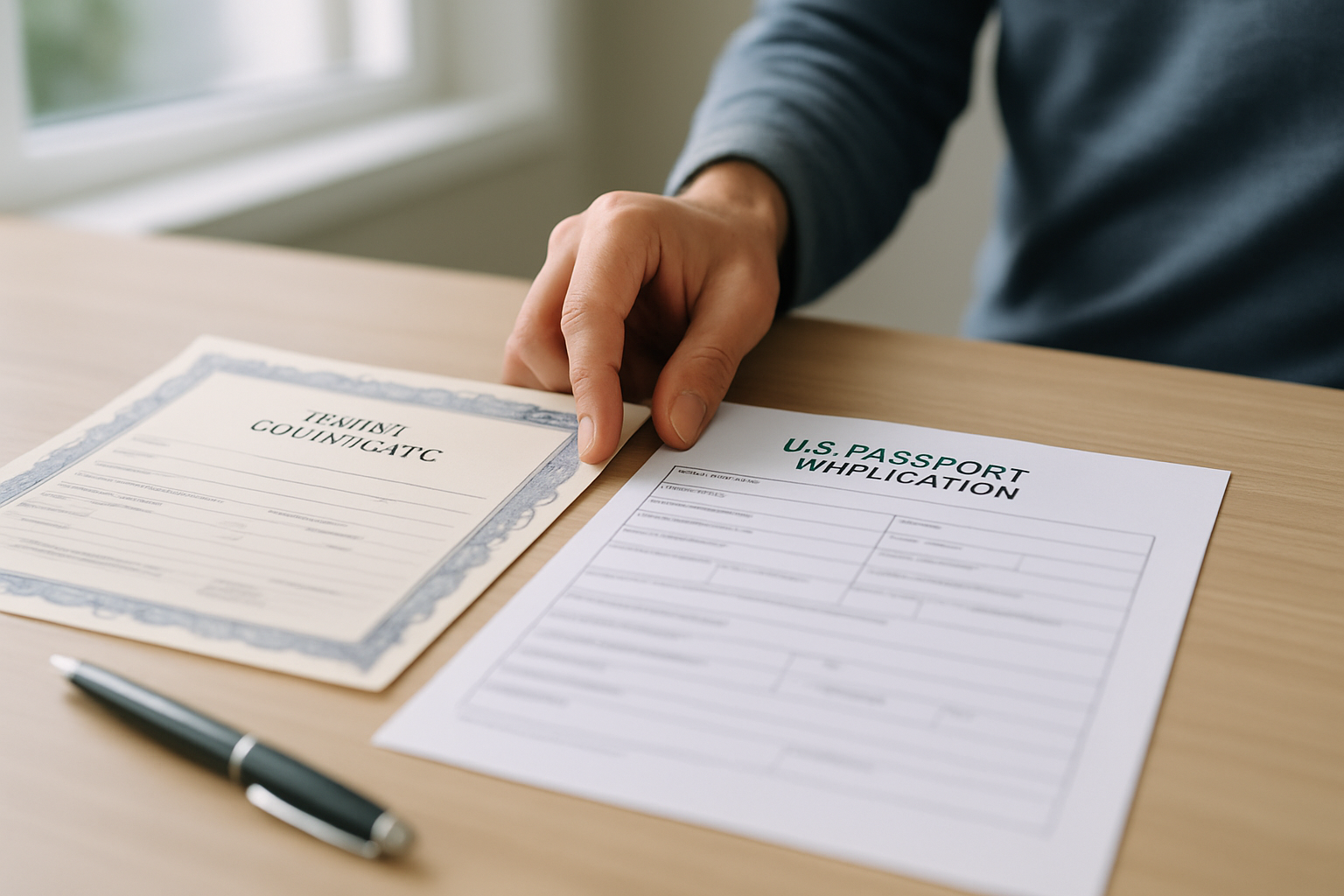
To apply for a U.S. passport with a birth certificate, you need a state-issued certified copy — not a photocopy, not the hospital souvenir. It must have a raised seal, a registrar’s signature, and list both parents’ names. If your certificate doesn’t meet those standards, order an amended or updated certified copy from your birth state before submitting your application.
At a glance
- Required document type: certified copy issued by state or county vital records
- Key features: raised or embossed seal, registrar’s signature, security paper
- Both parents’ names: preferred by State Dept; older certs without them may need supplemental documentation
- Filed within one year of birth: required; late-registered certs may need extra evidence
- Born abroad: use a Consular Report of Birth Abroad (CRBA), not a birth certificate
Why this matters
A birth certificate is the primary proof of U.S. citizenship for a first-time passport application. The State Department reviews it to establish that you were born in the United States and that you are who you claim to be. Every year, thousands of passport applications are delayed or rejected because the birth certificate submitted doesn’t meet the specific technical requirements — wrong document type, missing seal, damaged condition, or issued under a different name.
Understanding exactly what the State Department accepts — and what it doesn’t — before you submit your application saves you weeks of back-and-forth.
What makes a birth certificate acceptable for a passport
Not every piece of paper with “birth certificate” printed on it qualifies. The State Department’s DS-11 instructions specify the following requirements:
It must be a certified copy from a state or county vital records office
The document must be issued by the official vital records authority of the state where you were born. That’s the state health department or county vital records office — not the hospital, not a genealogy registry, not a court clerk (unless ordered through them as part of an adoption proceeding).
The issuing office name should appear on the document. If you’re not sure, look for the state name prominently displayed, a certificate number, and the issuing agency’s address or seal.
It must have a raised, embossed, or multicolored seal
Run your finger over the bottom or corner of the certificate. A genuine certified copy has a physical impression pressed into the paper, or a multicolored foil seal, or a prominently inked official stamp. This is the feature that most clearly distinguishes a certified copy from a photocopy — a photocopier can reproduce the image of a seal, but not the physical impression.
If your certificate is a flat, un-textured copy with no feel to it, it is almost certainly a photocopy.
It must have the registrar’s signature
The signature may be printed or stamped rather than hand-signed — modern vital records offices use signature facsimiles, and that’s fully accepted. What you’re looking for is the presence of a named official (typically “State Registrar” or “County Registrar”) who has signed or certified the document.
It must list both parents’ names
The State Department expects both parents’ full names on a U.S. birth certificate. Most certificates issued from the 1940s onward list both parents, but older certificates — particularly those from certain counties or rural areas — may only list the mother, or may show the father as “unknown.”
If your certificate is missing a parent’s name, that alone doesn’t automatically disqualify it, but it may prompt a request for supplemental documentation. If you know your birth certificate has this issue, contact your state’s vital records office and ask whether an amended certificate can be issued that captures both parents’ names from the original registration.
The file date must be within one year of birth
The State Department requires the birth to have been registered with vital records within one year of the birth date. A late registration — common for people born at home decades ago or in rural areas with limited record-keeping — shows a gap between birth date and date filed. Late-registered certificates are handled case-by-case and may require additional secondary evidence of citizenship.
Documents that don’t qualify
The State Department is explicit about what it won’t accept. Presenting any of the following will result in your application being returned:
| Document | Why it’s rejected |
|---|---|
| Hospital souvenir birth certificate | Not issued by a vital records office; no legal standing |
| Photocopy of a certified birth certificate | Cannot verify physical security features; explicitly prohibited |
| Printout or scan | Same issue as photocopy — no embossed seal |
| ”Informational copy” or “not for ID purposes” copy | Some states issue these — they say so on the face of the document |
| Foreign birth certificate (alone) | Not proof of U.S. citizenship; different rules apply |
| Baptismal record or school enrollment record | Secondary sources only; not accepted for passport applications |
If you’re not sure what type of certificate you have, see our certified birth certificate guide for how to check the physical features.
What to do if your certificate doesn’t meet the standards
Order a new certified copy from your birth state
This is the most common fix. Contact the vital records office of the state where you were born and request a new certified copy. Online expedited orders typically arrive in 2–5 business days. Mail orders take 4–12 weeks. Fees run $15–$50 per copy.
The key instruction: order from your state of birth, not your current state of residence. If you were born in Ohio but live in California, you order from Ohio. Our birth certificate replacement guide walks through the process state by state.
Request an amended certificate if parental information is incomplete
If the original record is on file but your certified copy is missing a parent’s name because of how the record was initially completed, your state’s vital records office may be able to issue an amended certificate based on supporting documents (a father’s affidavit, a DNA test, or court records, depending on the circumstances). Call the vital records office to ask what options exist.
Handle a name mismatch before submitting
If the name on your birth certificate doesn’t match the name on your driver’s license or other current ID, you need to submit a legal name-change document with your passport application. A marriage certificate, court order, or divorce decree creates the bridge. The State Department expects to see the chain from birth name to current legal name documented in writing.
If you were born outside the United States
U.S. citizens born abroad to American citizen parents don’t have a state-issued birth certificate. Instead, if their birth was registered at a U.S. embassy or consulate, they were issued a Consular Report of Birth Abroad (CRBA) — either Form FS-240 (issued after 1990) or Form DS-1350 (older). This document is the equivalent of a birth certificate for passport application purposes.
If you need to replace a lost CRBA, contact the U.S. State Department Passport Vital Records section in Washington, D.C. The process involves submitting Form DS-5513.
If your birth abroad was never registered with a U.S. consulate, contact the State Department directly to discuss what evidence of citizenship may be available.
Common pitfalls
- Submitting a photocopy. Even a high-quality color scan of a perfect certified copy will be returned. The State Department needs the physical original.
- Assuming a hospital souvenir is official. These decorative certificates are keepsakes, not government records. They are rejected every time.
- Forgetting to check the file date. If your birth was registered late, flag this before submitting — a late-registration gap can delay processing significantly.
- Not accounting for name discrepancies. A married name, a court-ordered name change, or an amended record needs a supporting legal document to connect the names.
- Ordering only one certified copy when you need two. If you’re also upgrading to a REAL ID in the same window, you’ll need a second certified copy — state fees are per copy, so order them at the same time.
What to do next
Check your birth certificate now against the criteria above: raised seal, registrar signature, both parents’ names, file date within one year of birth. If anything is missing or unclear, order a new certified copy from your birth state before booking a passport appointment.
Once your documents are in order, start your passport application and let us handle the paperwork, photo review, and expedited processing from there.
Frequently asked questions
Does a passport application require an original certified birth certificate or can I send a photocopy?
You must send the original certified copy. Photocopies, scans, and color printouts are explicitly prohibited by DS-11 instructions. After processing, the State Department returns your certified birth certificate.
What if my birth certificate only lists one parent?
It may still be accepted, but the State Department may request supplemental documentation. If possible, contact your birth state’s vital records office to see if an amended certificate can be issued with both parents’ names.
Can I use a hospital souvenir birth certificate for a passport application?
No. Hospital certificates are decorative keepsakes with no legal standing. They are not issued by a vital records office and are rejected for passport applications.
I was born outside the U.S. to American citizen parents. What do I submit?
If your birth was registered at a U.S. embassy or consulate, submit your Consular Report of Birth Abroad (CRBA, Form FS-240 or DS-1350) as proof of citizenship instead of a birth certificate.
My birth certificate shows a different name than my current ID. What do I do?
Submit a legal name-change document — a marriage certificate, court order, or divorce decree — alongside your birth certificate and passport application to document the name change chain.
How long does it take to get a replacement certified birth certificate before a passport appointment?
Online expedited orders from most states process in 2–5 business days. Mail orders take 4–12 weeks. Order well in advance of your passport appointment.
Sources: U.S. State Dept. DS-11 Application Instructions, U.S. State Dept. Vital Records. Information verified April 2026.
Need help with your passport application?
We handle the form, photo check, and tracking. Pay only after eligibility is confirmed.
Related reading
A certified birth certificate has a raised seal and registrar's signature. A photocopy doesn't count — even of a certified copy. Here's what agencies require.
Birth certificate replacement costs $15–$50 per state. Order from your state of birth, not where you live. Routine: 4–12 weeks. Expedited: 2–3 days.
Proof of citizenship for a U.S. passport: a certified birth certificate works for most people, but 4 other documents are accepted. Here's what the State Dept accepts.
DS-11 is the U.S. passport application for first-time applicants and lost/stolen replacements. Step-by-step guide to every section — fees, docs, and what to bring.