Certified Birth Certificate vs Photocopy: What Counts
A certified birth certificate has a raised seal and registrar's signature. A photocopy doesn't count — even of a certified copy. Here's what agencies require.
TL;DR
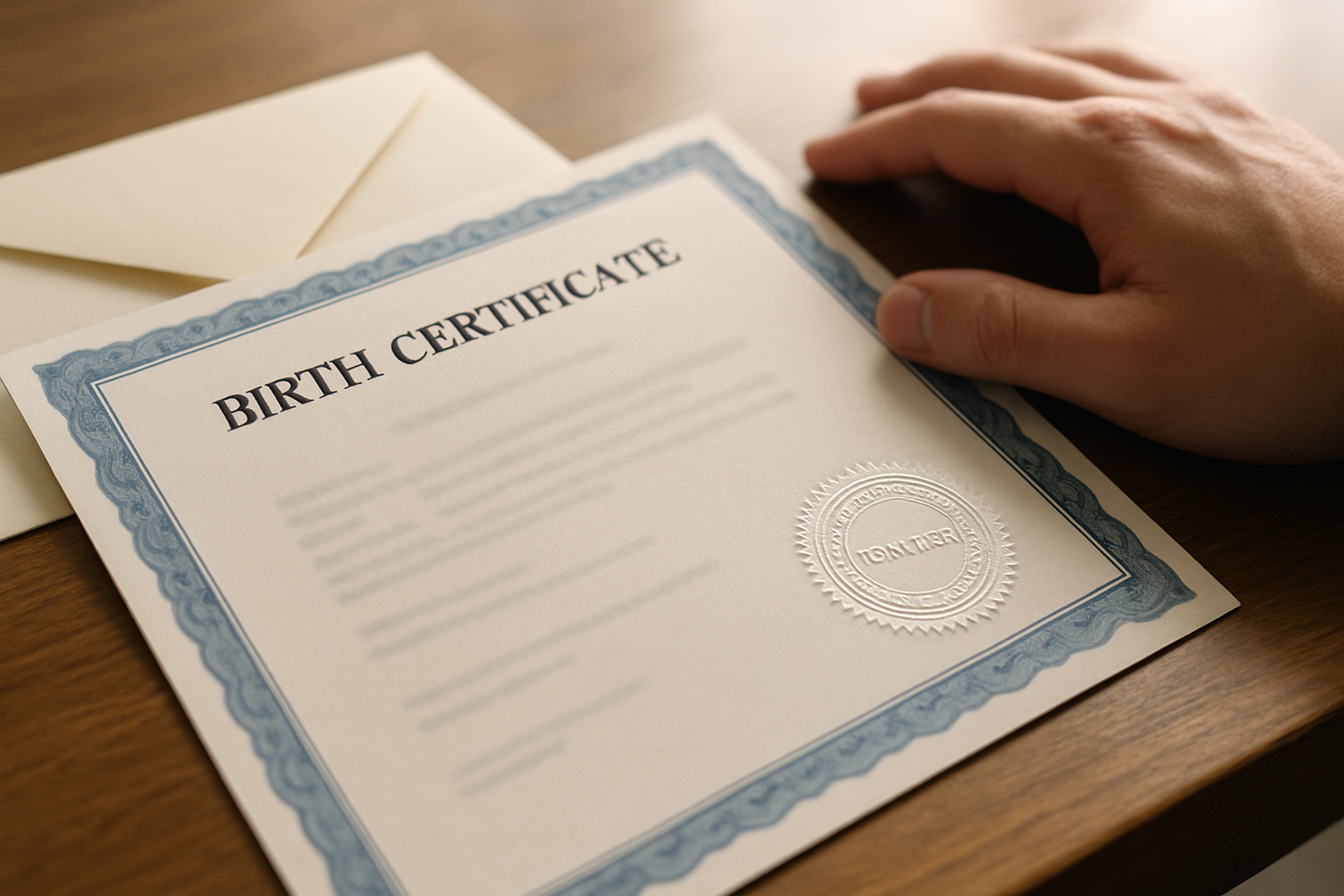
A certified birth certificate is a copy issued directly by a state or county vital records office — it has a raised or embossed seal, a registrar’s signature, and security paper. A photocopy of any kind does not count, even if it’s a photocopy of a certified copy. Agencies that ask for a certified birth certificate — the State Department, the DMV, school systems — will reject anything less.
At a glance
- Certified: issued by vital records office, has raised seal + registrar signature
- Not certified: photocopy, scan, printout, hospital souvenir certificate, family bible record
- Required for: passport applications, REAL ID, school enrollment, security clearances, marriage licenses
- How to order one: contact the vital records office of your state of birth
- Turnaround: 2–3 business days expedited, 4–12 weeks by mail
Why this distinction matters
People get tripped up at critical moments — arriving at a passport acceptance facility, a DMV appointment, or a school enrollment desk with a photocopy. They assume a photocopy of an official document carries the same weight as the original. It doesn’t.
Governments require the original certified copy for two reasons: to verify the document’s authenticity through physical security features, and to ensure you’re presenting the actual record rather than a manipulated scan. A photocopy can be altered in ways that are difficult to detect; a raised seal on security paper cannot be duplicated by a printer.
The practical fix is simple: order a fresh certified copy from your state vital records office. Once you understand what “certified” means and what doesn’t qualify, you won’t waste a trip.
What a certified birth certificate actually looks like
A certified birth certificate has several features that distinguish it from a simple copy:
Raised or embossed seal. Run your finger across the bottom or corner of the document. A certified copy has a physical impression pressed into the paper — you can feel it. Some states use a multicolored foil seal or an inked stamp instead of a traditional embossed seal, but some form of official seal is always present.
Registrar’s signature. The document bears the original or facsimile signature of the state or county vital records registrar. This is the official certifying that the record is a true copy of the document on file.
Security paper. Most states now print certified copies on specially manufactured paper with background patterns, watermarks, or microprinting that cannot be reproduced by a standard photocopier or scanner.
Official file number and dates. The document includes a certificate number, the date of registration (which may differ from the birth date), and typically a “date issued” stamp showing when this particular certified copy was produced.
Return address and contact information. Many modern certified copies include the name and address of the issuing vital records office, so the receiving agency can contact them to verify authenticity if needed.
What doesn’t count as certified
Each of the following is routinely presented at government counters and routinely rejected:
Photocopies. A photocopy of a certified birth certificate — even a high-quality color scan — is not a certified document. The State Department’s DS-11 instructions explicitly state: “Do not send a photocopy of a certified birth certificate.” The same rule applies to DMVs for REAL ID.
Hospital-issued souvenir birth certificates. When a baby is born in a hospital, the hospital often gives parents a decorative certificate with the baby’s footprints and birth details. This is a commemorative keepsake with no legal standing. It was not issued by a vital records office, it has no official seal from a registrar, and it carries no evidentiary weight for any official purpose.
“Informational” or “heirloom” copies. Some states and counties issue copies labeled “informational copy only — not valid for identity purposes.” These are specifically designed for family keepsakes and are explicitly rejected for passports, REAL ID, and school records.
Older certificates without security features. An authentic certified copy from decades ago may look different from a modern one — it may have a different seal style, older printing methods, or a different format. Age alone doesn’t disqualify a document, but if it lacks a visible seal and signature, it may be challenged. If you have an old certificate with these concerns, order a fresh certified copy from vital records.
Family bible records, baptismal records, or school enrollment records. These are secondary sources used historically for identity purposes but are no longer accepted for passports or REAL ID. The State Department permits limited exceptions for people born before a certain year (before 1930 or thereabouts) who may have no formal birth registration, but those are narrow edge cases.
Where a certified birth certificate is specifically required
Passport applications
The U.S. State Department requires a certified birth certificate as proof of U.S. citizenship on Form DS-11 (first-time applications). The accepted document must have:
- A state or county raised seal or stamp
- The registrar’s signature
- The date the record was filed (which should be within one year of your birth date)
After reviewing your application, the State Department returns your certified birth certificate to you. If your birth certificate is in poor condition or very old, consider ordering a fresh one before applying — it reduces the risk of rejection.
For passport renewal on Form DS-82, you submit your most recent passport and don’t need to resubmit your birth certificate. But for a first-time adult or child passport (Form DS-11), the certified copy is required.
REAL ID at the DMV
State DMVs require a certified birth certificate as the primary proof of identity document for a REAL ID upgrade. The same rules apply: it must be an original certified copy with an official seal. See REAL ID requirements for the full document checklist.
School enrollment
Most public school districts in the United States require a certified birth certificate at initial enrollment. The requirements vary by district and state, but the common standard is the same: a copy issued by vital records with a seal. School officials generally won’t accept hospital souvenir certificates.
Security clearances and federal employment
Federal background investigations for security clearances require applicants to submit documentation of citizenship, typically a certified birth certificate or a U.S. passport as supporting evidence.
Marriage licenses
Many county clerks require a certified birth certificate to verify age and identity when issuing a marriage license, though requirements vary significantly by state and county.
How to tell if your current certificate is certified
Before ordering a replacement, check what you have:
- Run your finger across the document. If you feel a raised impression — particularly in the lower third or corner — that’s the embossed seal. It can be subtle on older documents.
- Look for a printed seal or colored stamp. Some states use an inked circular stamp rather than an embossed impression. It should clearly name the state or county and the vital records office.
- Look for a registrar signature. It may be printed or stamped rather than hand-signed, which is normal and accepted.
- Check the paper. Hold it up to light. If you see a watermark or the paper has a distinct texture, it’s likely security paper.
- Look for “certified copy” language. Most modern certified copies include language such as “This is a true and correct copy of the original vital record on file.”
If your document passes these checks, it’s almost certainly a valid certified copy. If it’s a plain photocopied sheet with no seal or texture, it isn’t.
How to order a fresh certified copy
Contact the vital records office in the state where you were born — not your current state of residence. Each state’s vital records office maintains the original records and can issue certified copies.
Most states offer three ordering methods:
- Online via the state’s vital records website or an authorized vendor (fastest, small service fee)
- By mail using the state’s request form plus a money order or check (lowest cost, 4–12 week wait)
- In person at the vital records office or county clerk (fastest — same day or next business day in many states)
Fees typically run $15–$50 per certified copy. If you need one for multiple purposes simultaneously — a passport application and a REAL ID upgrade at the same time — order two copies at once to save the trouble of a second request. For a full walkthrough, see our birth certificate replacement guide.
Common pitfalls
- Submitting a photocopy. The receiving agency will reject it and mail it back, adding weeks to your timeline.
- Assuming a souvenir is official. Hospitals issue keepsakes, not certified records. They look official but are not.
- Presenting an “informational copy.” Some states print these by default when you order online from certain platforms. Make sure you’re ordering a certified copy, not an informational one.
- Ordering from the wrong state. Your current state has no record of your birth. Always order from your birth state.
- Assuming one copy handles everything simultaneously. The State Department returns your birth certificate, but if you’re also visiting the DMV in the same week, you’ll need a second copy.
What to do next
If you need a certified birth certificate and don’t have one on hand, order it now — before you book any government appointment that requires it. State vital records offices can mail a certified copy in days with expedited processing, but mail orders in high-volume states can take weeks.
Once you have a certified copy, use it for your first-time passport application, your REAL ID upgrade, or any other official process that calls for it.
Frequently asked questions
What makes a birth certificate “certified”?
A certified birth certificate is issued by the state or county vital records office, carries the registrar’s official signature and an embossed or stamped seal, and is printed on security paper. A photocopy of any kind is not certified.
Can I use a photocopy of my birth certificate for a passport application?
No. The State Department requires an original certified copy with a raised or embossed seal. A photocopy or scan will be rejected. After processing, your certified copy is returned to you.
Is a hospital souvenir birth certificate the same as a certified copy?
No. Hospital certificates are decorative keepsakes with no legal standing. They are not issued by a vital records office and are rejected for passports, REAL ID, and school enrollment.
How do I know if my birth certificate is certified?
Feel for a raised embossed seal. Look for a registrar’s signature, security paper with a watermark, and language stating it’s a “true and correct copy.” If it’s a plain photocopy with none of these features, it isn’t certified.
Does every agency require an original certified copy, or can I use the same one multiple times?
Many agencies use the same original and return it. For simultaneous needs, order two or three certified copies at once rather than resubmitting a single copy multiple times.
My birth certificate is from another country. Does it count?
For U.S. government purposes like a first-time passport application, a foreign birth certificate is not proof of U.S. citizenship. You would need a different citizenship document — such as a Consular Report of Birth Abroad or a naturalization certificate.
Sources: U.S. State Dept. DS-11 Instructions, DHS REAL ID Documentation Requirements. Information verified April 2026.
Related reading
Birth certificate replacement costs $15–$50 per state. Order from your state of birth, not where you live. Routine: 4–12 weeks. Expedited: 2–3 days.
Proof of citizenship for a U.S. passport: a certified birth certificate works for most people, but 4 other documents are accepted. Here's what the State Dept accepts.
Real ID requirements: proof of identity, SSN, two address proofs, and name-change docs. Bring originals. Here's the full accepted-document list.
How to get a birth certificate online: order through your state vital records office or an approved third-party service. Costs $15–$50, ships in 4–12 weeks.