Cruise Documentation: Passport, Birth Certificate, or REAL ID?
Cruise documentation depends on your itinerary. Here's exactly which documents work for closed-loop vs open-loop cruises, and why REAL ID isn't one of them.
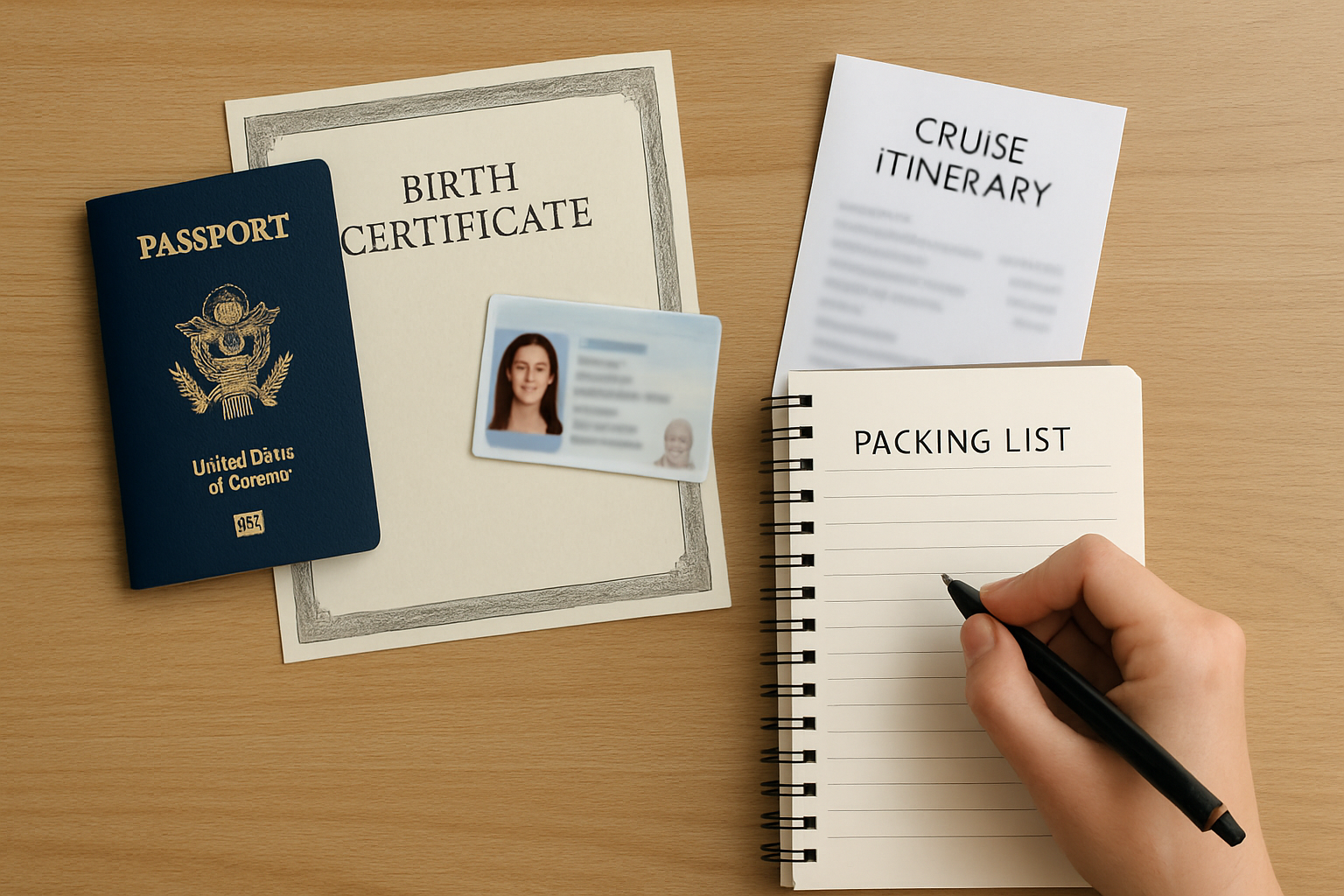
TL;DR
Your cruise documentation depends on your itinerary. On a closed-loop cruise — one that departs and returns to the same U.S. port — U.S. citizens can sail with a certified birth certificate plus a government-issued photo ID. On an open-loop cruise, a passport book is required. A REAL ID alone never satisfies cruise requirements, regardless of itinerary.
At a glance
- Closed-loop cruise: certified birth certificate + photo ID (adults); birth certificate only (kids under 16); or passport book/card
- Open-loop cruise: passport book required for virtually all passengers
- REAL ID: not a substitute for a birth certificate on any cruise
- Passport card: valid for closed-loop cruises, not for international flights or open-loop itineraries
- Always recommended: passport book — it covers every cruise scenario plus emergencies
Why cruise documentation is different from airport documentation
Airport security runs on a simple rule: any federally accepted ID works for domestic flights, and a passport book works for international ones. Cruises are more complicated.
When a ship sails from Miami to Nassau and back, it’s technically crossing an international border twice — once leaving the U.S. and once returning. That means U.S. Customs and Border Protection (CBP) is involved at re-entry, just as if you’d flown abroad. But cruise travel has a special exemption under the Western Hemisphere Travel Initiative (WHTI) that allows certain documents beyond just a passport.
The other wrinkle is that cruise lines have their own documentation policies that can be stricter than CBP’s minimum requirements. They also check documents at embarkation — meaning even if CBP would let you back into the country, your cruise line might not let you board.
Closed-loop vs open-loop: the foundational distinction
Closed-loop cruises
A cruise is closed-loop when it:
- Departs from a U.S. port (Miami, Galveston, Port Canaveral, Seattle, Baltimore, New York, etc.)
- Visits foreign destinations
- Returns to the same U.S. port it left from
This is the most common type of cruise itinerary. A 7-night Caribbean sailing from Fort Lauderdale that returns to Fort Lauderdale is closed-loop. So is a Pacific cruise from Seattle that returns to Seattle.
Open-loop cruises
An open-loop cruise starts in one location and ends in another. Common examples:
- Repositioning cruises (Miami to Barcelona as the ship moves for a new season)
- Transcanal cruises (Fort Lauderdale to Los Angeles via the Panama Canal)
- Alaska sailings that start in Seattle and end in Anchorage or vice versa
- Itineraries starting in a Caribbean port that passengers fly into
Open-loop cruises generally require a full passport book for all passengers, because you’re re-entering the U.S. through a different port than you departed from and the WHTI exemption doesn’t apply.
One common edge case: a cruise that starts and ends in U.S. ports but passes through a non-WHTI country (such as Panama) may require a passport at some ports regardless of the closed-loop status. Always check the itinerary in detail.
Documents accepted on closed-loop cruises
U.S. citizen adults (16 and older)
You need one of the following:
Option 1 — Passport book: The universal recommendation. Works for every cruise type, every port, every emergency. No additional documents needed.
Option 2 — Passport card: Valid for closed-loop sea crossings. Wallet-sized, costs less than a book. Does not work for international air travel, so if you fly to meet the ship, you need the book.
Option 3 — Certified birth certificate + government-issued photo ID: Both documents are required together. The birth certificate must be an official certified copy from the state or county vital records office — with a raised or printed seal. A photocopy does not qualify. The photo ID can be any current government-issued ID, including a non-REAL ID driver’s license. It does not need to be REAL ID compliant for cruise CBP purposes, though some cruise lines may apply stricter standards.
Children under 16
Children under 16 on closed-loop cruises only need a certified birth certificate — no photo ID required. This exemption is specific to closed-loop sea travel. It does not apply to air travel, and it does not apply to open-loop itineraries.
Why REAL ID doesn’t solve cruise documentation
This is a common misconception. The REAL ID standard applies to domestic air travel and access to federal facilities. It has nothing to do with the Western Hemisphere Travel Initiative or international sea re-entry.
On a cruise:
- A REAL ID driver’s license can serve as the government-issued photo ID portion of the birth certificate + photo ID combination.
- A REAL ID driver’s license cannot replace the need for a birth certificate or passport.
- A REAL ID driver’s license alone satisfies no cruise documentation requirement.
If you see articles suggesting REAL ID “works” for cruises, they’re referring to its role as a qualifying photo ID alongside a birth certificate — not as a standalone document. Read that carefully, because the distinction matters at the pier.
What cruise lines actually check
Cruise line policies must meet CBP’s minimum requirements, but they can be stricter. None of the major lines accept a REAL ID alone as the only document. Here’s what the general landscape looks like:
Royal Caribbean accepts the birth certificate + photo ID combination on closed-loop itineraries for U.S. citizens. They note that a passport is required if you fly to join the ship at any port. Review their current requirements at royalcaribbean.com.
Carnival Cruise Line follows the same general policy for closed-loop U.S. sailings. They recommend a passport and note it’s required if your travel plans might change. Check carnival.com for the latest.
Norwegian Cruise Line allows the birth certificate + ID combination on qualifying closed-loop itineraries for U.S. citizens. Confirm directly with NCL for current requirements before booking.
Disney Cruise Line follows similar WHTI-based policies for its U.S. closed-loop itineraries. Check their site directly for documentation details.
The consistent pattern: for the cruise itself, CBP’s WHTI rules determine the minimum. The cruise line’s own check-in requirements may add to those minimums. Neither will accept REAL ID alone.
Why a passport book is still the smart choice
The birth certificate option works perfectly — until circumstances change. Here are the real scenarios where it leaves you exposed:
Medical emergency. A health event serious enough to require air evacuation from a foreign port requires a valid passport to board any flight back to the U.S. A birth certificate is not accepted for air re-entry under any normal circumstance. This is the most important reason to carry a passport even on a closed-loop cruise.
Missed the ship. If you miss re-boarding at a port stop, you’re in a foreign country and need to get home by air. That requires a passport.
Itinerary changes. Ships occasionally divert to alternate ports due to weather, mechanical issues, or local conditions. An alternate port might be in a country with stricter entry requirements.
Flying to embarkation. If you fly to meet your ship — even for a closed-loop itinerary — you need a passport for the flight. Many travelers don’t realize this.
Future flexibility. A passport book covers every trip for 10 years. Getting one now means you never have to ask this question again.
Comparing your options side by side
| Document | Closed-loop cruise | Open-loop cruise | International flight | Notes |
|---|---|---|---|---|
| Passport book | Yes | Yes | Yes | Universal — best choice |
| Passport card | Yes | No | No | Good backup for closed-loop only |
| Birth cert + photo ID | Yes (adults) | No | No | Both docs required; certified only |
| Birth cert alone | Yes (under 16) | No | No | Children’s exemption only |
| REAL ID alone | No | No | Domestic only | Not a cruise document |
Common pitfalls
- Assuming REAL ID covers the cruise. It doesn’t — not as a standalone document.
- Bringing an unofficial birth certificate. Hospital-issued birth cards, photocopies, or unofficial prints do not meet CBP requirements. You need a certified copy with an official government seal.
- Flying to the ship without a passport. Any international flight — even a connection in the Caribbean — requires a passport book.
- Open-loop cruises disguised as simple trips. Read your itinerary carefully. A cruise ending in a different port than it started is open-loop, regardless of how the booking site presents it.
- Expired photo ID. The government photo ID in the birth certificate + photo ID combination must be current. An expired license does not satisfy the requirement.
What to do next
If you’re sailing on a closed-loop cruise and have a valid certified birth certificate plus a current photo ID, you’re covered for CBP purposes — confirm the same with your specific cruise line.
If you want to be covered for every scenario — including medical emergencies, missed ships, or future open-loop itineraries — getting a passport is the right move. A passport card is a middle-ground option: cheaper than the book, valid for closed-loop sea crossings, fits in your wallet.
Start a passport application at egovrush — we’ll handle the paperwork, photo review, and processing so you’re ready before you board.
Frequently asked questions
Can you go on a cruise without a passport?
Yes, on a closed-loop cruise. U.S. citizens can board with a certified birth certificate plus a government-issued photo ID. This is allowed under CBP’s Western Hemisphere Travel Initiative. Open-loop cruises almost always require a passport.
Does a REAL ID work for cruises?
No — not as a standalone document. A REAL ID driver’s license can serve as the photo ID portion of the birth certificate + photo ID combination, but it cannot replace the birth certificate requirement or stand in for a passport.
What is the difference between a closed-loop and open-loop cruise?
A closed-loop cruise departs from and returns to the same U.S. port. An open-loop cruise starts at one port and ends at a different one. Open-loop itineraries require a passport for virtually all passengers.
Why is a passport book recommended even on closed-loop cruises?
A medical emergency requiring air evacuation back to the U.S. requires a valid passport. If you miss the ship in a foreign port, you need a passport to fly home. The birth certificate combination only works for the cruise itself under ideal circumstances.
Can kids cruise without a passport?
Children under 16 on closed-loop cruises only need a certified birth certificate — no photo ID required. This exemption applies only to closed-loop sea travel, not air travel.
Does a passport card work for cruises?
Yes, for closed-loop cruises. A U.S. passport card is accepted at CBP for sea re-entry and works for land and sea crossings with Canada, Mexico, and the Caribbean. It does not work for international flights or open-loop itineraries.
Sources: CBP Western Hemisphere Travel Initiative, travel.state.gov U.S. Passports. Cruise line policies verified April 2026 — always confirm with your specific carrier before sailing.
Need help with your passport application?
We handle the form, photo check, and tracking. Pay only after eligibility is confirmed.
Related reading
On a closed-loop cruise, U.S. citizens can board with a birth certificate plus photo ID. Here's what qualifies, what doesn't, and why a passport is still smarter.
Planning a closed-loop Caribbean cruise? Here's exactly which documents you need in 2026 — passport, birth certificate, or card — and what Caribbean ports require.
Passport card vs book: the card costs less and fits in your wallet, but only works for land and sea travel. Here's which one you actually need in 2026.
REAL ID enforcement is in full effect at every U.S. airport. If your driver's license isn't compliant, here's exactly what flies and what doesn't in 2026.