DS-3053: How to Get a Notarized Parental Consent Form
DS-3053 is the notarized parental consent form required when one parent can't attend a child's passport appointment. Here's how to fill it out correctly in 2026.
TL;DR
Form DS-3053 lets one parent apply for a child’s passport when the other parent can’t attend the appointment. The absent parent signs it in front of a notary — not before — and the form must be dated within 3 months of the appointment. Download the current version at travel.state.gov.
At a glance
- Form name: DS-3053, Statement of Consent: Issuance of a Passport to a Minor Under Age 16
- Who uses it: One parent or guardian when the other parent/guardian can’t attend the passport appointment
- Must be notarized: Yes — absent parent signs in front of a notary only
- Validity window: Notary signature must be within 3 months of the appointment date
- Also required: Photocopy of the absent parent’s government-issued photo ID
- Download: travel.state.gov/ds-3053
Why DS-3053 exists
U.S. law requires both parents or legal guardians to consent before a child under 16 can receive a passport. The rule is meant to prevent international parental abduction — a passport is what makes it possible to take a child abroad, so federal law puts two signatures between the application and the approval.
Most of the time this is a paperwork hurdle, not a legal obstacle. Parents are separated, working different schedules, or one is traveling. DS-3053 resolves all of those situations cleanly as long as both parents agree the child should have a passport.
If you’re applying for a child’s passport and only one parent will be present at the appointment, get started on DS-3053 early. The 3-month validity window means you can’t notarize it too far in advance.
When you need DS-3053
You need DS-3053 when:
- Applying for a child’s first passport (form DS-11) and only one parent or guardian can attend the acceptance facility appointment
- The child is under age 16
- Both parents have legal parental rights (no sole-custody order)
You do not need DS-3053 when:
- Both parents attend the appointment together
- You have a court order granting sole custody (submit that instead)
- The other parent is deceased (submit a certified copy of the death certificate)
- The child is 16 or 17 (different rules apply — parental consent is still required but the specific form and process differs)
How to get and fill out DS-3053
Step 1: Download the current version
Go to travel.state.gov and download DS-3053 directly. Don’t use a saved version from months ago — the State Department occasionally revises the form, and old versions are rejected. Print it out; it cannot be submitted electronically.
Step 2: Fill in the child’s information
Complete the child’s full legal name, date of birth, and place of birth exactly as they appear on the birth certificate. The attending parent and the relationship to the child are also filled in at this stage. Leave the signature and date lines blank — those are completed only in front of the notary.
Step 3: The absent parent signs before a notary
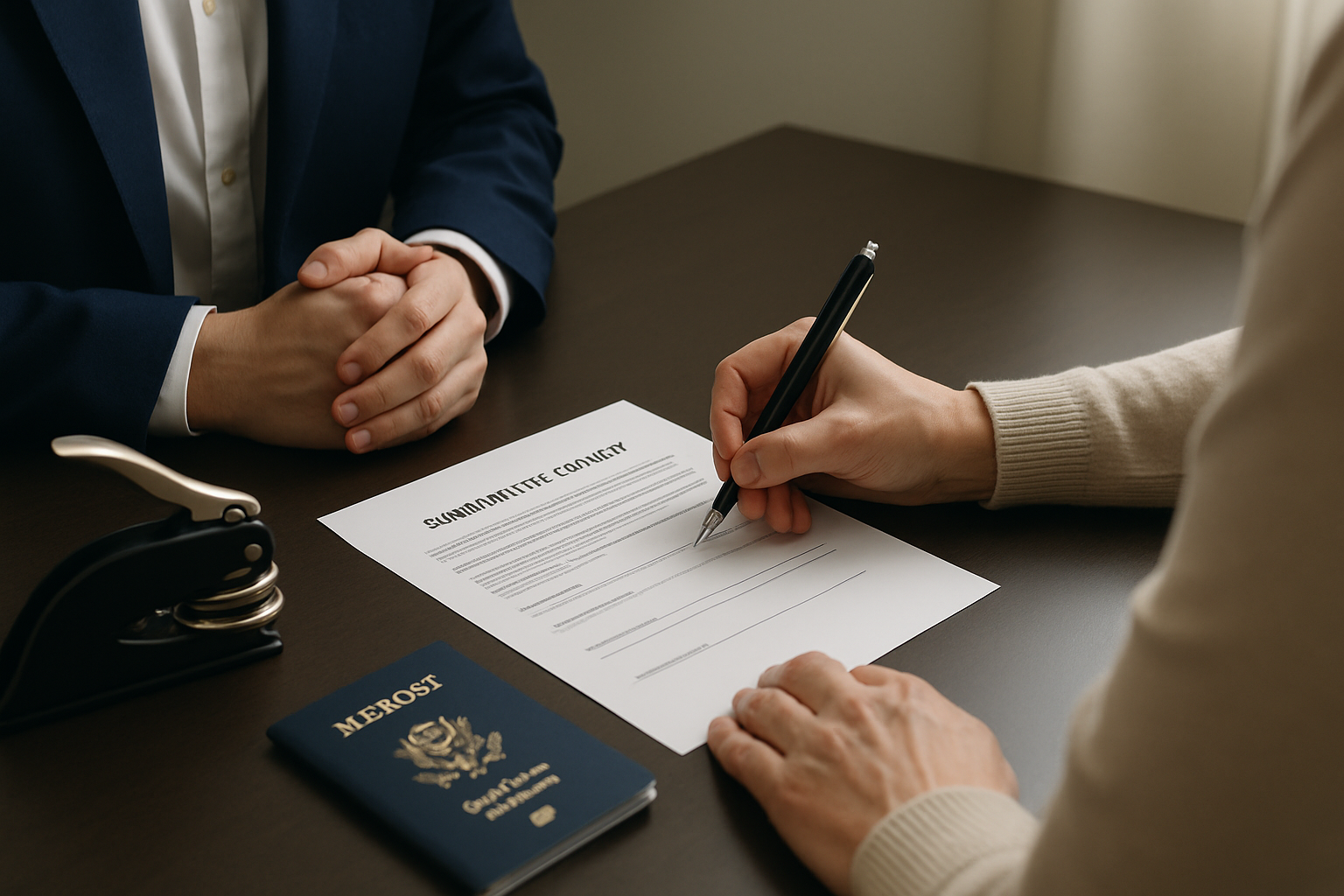
This is the most misunderstood step. The absent parent must appear before a notary public and sign the form there. Signing it at home and then getting it notarized later is not allowed — the notary is witnessing the signature in real time.
Notaries are available at:
- Banks (many offer free notary services to account holders)
- UPS Store and FedEx Office locations
- Law offices
- Public libraries (some)
- Online notary services (remote online notarization, where state law permits)
The notary will check the absent parent’s ID, watch them sign, and apply the seal and signature. That date on the notary seal is what establishes the 3-month window.
Step 4: Make a photocopy of the absent parent’s ID
You must include a photocopy of the absent parent’s valid, government-issued photo ID with the DS-3053 when submitting the child’s passport application. A driver’s license, state ID, or U.S. passport works. The copy does not need to be notarized — just legible and current.
Step 5: Submit within 3 months
The passport appointment must happen within approximately 3 months of the date on the notary seal. If you need to reschedule the appointment past that window, the form expires and the absent parent must sign a new one.
What if the other parent won’t sign?
If the other parent refuses to consent, you have a few options — none of them quick:
- Court order for sole custody — A certified copy of a custody order giving you sole authority to travel internationally with the child substitutes for DS-3053. Many custody orders don’t explicitly cover passports, so you may need a lawyer to modify the order.
- Court order specifically authorizing the passport — A judge can issue an order permitting the passport application even without the other parent’s consent. This requires a family court filing.
- Notice of intent to apply — In limited circumstances, the State Department allows the applying parent to place a 90-day hold while attempting to notify the absent parent. This process has specific requirements and isn’t a workaround for avoiding consent.
These paths take time. If a trip is already booked, none of them are fast enough. Build in a cushion.
DS-3053 for the egovrush pre-fill tool
If you’re using egovrush to apply for a child’s passport, our intake wizard walks you through exactly what’s needed before the appointment. The child passport application flow asks about parent availability upfront, flags when DS-3053 is required, and provides instructions for the absent parent so nothing is missing on the day of the appointment.
Common pitfalls
- Pre-signing the form before the notary appointment. The notary must witness the signature. A pre-signed form will be rejected at the passport office.
- Using an expired or outdated version of DS-3053. Always download from travel.state.gov on the day you print it.
- Notarizing more than 3 months before the appointment. The form has an expiration. If the appointment date slips, you may need a new form.
- Forgetting the photocopy of the absent parent’s ID. This is a separate requirement from the notarized form itself. Missing it means the appointment can’t proceed.
- Confusing DS-3053 with DS-3034. DS-3034 is the form for a parent or guardian authorizing a third party (like a grandparent) to apply on their behalf — a different situation entirely.
What to do next
If you’re applying for a child’s passport, start the DS-3053 process as soon as you have an appointment date — or as soon as you’re booking travel. The 3-month window is easy to stay inside if you start early.
egovrush handles the entire child passport application process: eligibility check, document checklist, photo review, and guided filing. Start a child passport application and we’ll walk you through each step.
Sources: Children’s Passports (Under 16) — travel.state.gov, DS-3053 form download — travel.state.gov. Requirements verified April 2026.
Frequently asked questions
What is Form DS-3053 used for?
DS-3053 is the Statement of Consent form that allows one parent or guardian to apply for a child’s U.S. passport without the other parent present. Both parents must consent to a minor’s passport — DS-3053 is how the absent parent gives that consent.
Does DS-3053 need to be notarized?
Yes. The absent parent’s signature must be notarized. The parent signs in front of a notary — pre-signing at home and getting it notarized later is not allowed.
How long is DS-3053 valid?
The notary signature must be dated within 3 months of the child’s passport appointment. If you reschedule past that window, you need a new form.
What if the absent parent refuses to sign DS-3053?
If the other parent won’t sign, you’ll need a sole-custody court order or a court order specifically authorizing the passport. Both require legal proceedings and take time.
What photo ID copy must accompany DS-3053?
A photocopy of the absent parent’s valid government-issued photo ID — driver’s license, state ID, or U.S. passport — must be submitted with the DS-3053.
Can DS-3053 be submitted by mail?
Children under 16 must apply in person at an acceptance facility, with DS-3053 included. Children 16–17 may use different procedures; check travel.state.gov for current rules.
Need help with your passport application?
We handle the form, photo check, and tracking. Pay only after eligibility is confirmed.
Related reading
Passport card vs book: the card costs less and fits in your wallet, but only works for land and sea travel. Here's which one you actually need in 2026.
Proof of citizenship for a U.S. passport: a certified birth certificate works for most people, but 4 other documents are accepted. Here's what the State Dept accepts.
REAL ID enforcement is in full effect at every U.S. airport. If your driver's license isn't compliant, here's exactly what flies and what doesn't in 2026.