REAL ID vs Enhanced Driver's License: What's the Difference
REAL ID vs EDL: both work for domestic flights, but only an EDL lets you cross into Canada or Mexico by land. Here's when each makes sense and which 5 states issue EDLs.
TL;DR
A REAL ID and an Enhanced Driver’s License (EDL) both let you board domestic flights — they’re equally valid at TSA checkpoints. The difference is that an EDL also lets you cross into Canada or Mexico by land or sea, functioning like a passport card for border crossings. Only five states issue EDLs: Washington, Michigan, Minnesota, New York, and Vermont. If you live in one of those states and cross the northern or southern border by land, an EDL may be worth the extra cost over a standard REAL ID.
At a glance
| REAL ID | Enhanced Driver’s License (EDL) | |
|---|---|---|
| Domestic flights | Yes | Yes |
| Federal buildings | Yes | Yes |
| Canada/Mexico land border | No | Yes |
| Canada/Mexico by air | No | No |
| Available in | All 50 states + DC | WA, MI, MN, NY, VT only |
| Typical cost | $25–$50 | $30–$60 |
| U.S. citizenship required | No (lawful presence sufficient) | Yes — citizens only |
| RFID chip | No | Yes |
Fees verified approximately April 2026. Confirm current fees at your state DMV.
Why this matters
Since TSA began full REAL ID enforcement on May 7, 2025, most Americans have been focused on whether their driver’s license has the star in the corner. But for residents of the five EDL-issuing states, there’s a related question worth asking: should you get the standard REAL ID, or upgrade to an EDL?
The answer comes down to how you travel. Both documents get you through airport security for domestic flights. The EDL does something extra. If you drive to Canada for a weekend, take a ferry to Victoria, or frequently cross the U.S.-Mexico border at a land port of entry, the EDL eliminates the need to bring a passport for those trips.
For travelers who already have a valid passport, the calculation shifts — the passport handles everything the EDL does, plus international air travel. But if you prefer to travel light with just your wallet, the EDL option is worth knowing.
What is an Enhanced Driver’s License?
An EDL is a driver’s license or non-driver state ID that has been enhanced to meet two standards simultaneously:
- REAL ID compliance — meets the federal minimum security and identity-verification requirements under the REAL ID Act.
- Western Hemisphere Travel Initiative (WHTI) compliance — recognized by U.S. Customs and Border Protection (CBP) as a valid travel document for U.S. citizens re-entering the country from Canada, Mexico, Bermuda, or the Caribbean by land or sea.
To achieve WHTI compliance, EDLs include a radio-frequency identification (RFID) chip that can be read by CBP readers at land border crossings. The chip stores a unique identifier that links to your record in CBP’s database — it does not store your personal information on the card itself.
The CBP Western Hemisphere Travel Initiative page lists the EDL as one of the accepted documents alongside a passport, passport card, NEXUS card, SENTRI card, and FAST card.
The five states that issue EDLs
The federal government authorized states to issue EDLs under WHTI, but each state must negotiate a separate agreement with DHS. As of 2026, only five states have done so:
| State | EDL name | Approximate fee | Notes |
|---|---|---|---|
| Washington | Enhanced Driver License (EDL) | $54 | Available for DL and ID cards |
| Michigan | Enhanced Driver’s License | $45 | Both EDL and standard REAL ID available |
| Minnesota | Enhanced Driver’s License | $32 | Standard REAL ID also available |
| New York | Enhanced Driver License | $30–$40 | Choose at time of application |
| Vermont | Enhanced Driver License | $30 | Very low volume; fast turnaround |
No other states issue EDLs. If you live in California, Texas, Florida, or any of the other 45 states, you can only get a standard REAL ID-marked license. Your options for border crossings are then a passport book, a passport card, a NEXUS card, or a SENTRI card.
REAL ID vs EDL: when each makes sense
Choose a standard REAL ID if:
- You live in a non-EDL state (no choice)
- You rarely or never cross into Canada or Mexico by land or sea
- You already have a valid U.S. passport that handles border crossings
- You want the cheapest compliant option and don’t cross borders
- You are not a U.S. citizen (EDLs are citizens-only; REAL ID is available to lawful residents)
Choose an EDL if:
- You live in WA, MI, MN, NY, or VT
- You regularly drive or take a ferry into Canada or frequent the U.S.-Mexico land border
- You want to leave your passport at home on day trips or weekend trips across the border
- You’re a U.S. citizen and can meet the citizenship-proof requirement at the DMV
Skip both and use a passport if:
- You travel internationally by air even occasionally — the passport covers domestic flights, international flights, and land/sea border crossings with one document
- You want the maximum flexibility regardless of state
- Your travel patterns aren’t predictable
The Passport Card vs Passport Book article covers when the wallet-sized card makes sense. The passport card costs about $65 (new) and covers domestic flights and land/sea crossings, making it competitive with an EDL — and it’s available to residents of all 50 states.
Document requirements for an EDL vs a REAL ID
Both require the standard four document categories: proof of identity, Social Security number, two proofs of state address, and name-change documents if applicable. The key difference is in the identity proof category.
REAL ID: lawful presence in the U.S. is sufficient. U.S. citizens, permanent residents, and certain non-immigrant visa holders can all obtain a REAL ID with the appropriate documents.
EDL: U.S. citizenship is required. Acceptable citizenship proofs are:
- Certified U.S. birth certificate
- U.S. passport book or passport card (valid or expired within 5 years — check your state’s rule)
- U.S. Certificate of Naturalization
- Certificate of Citizenship
Permanent residents, visa holders, and DACA recipients cannot obtain an EDL. This is a hard rule under the WHTI program. If you are not a U.S. citizen and need domestic flight ID, the REAL ID-compliant driver’s license (or a passport if eligible) is your path.
How to read your license to identify which type you have
Look at the front of your driver’s license:
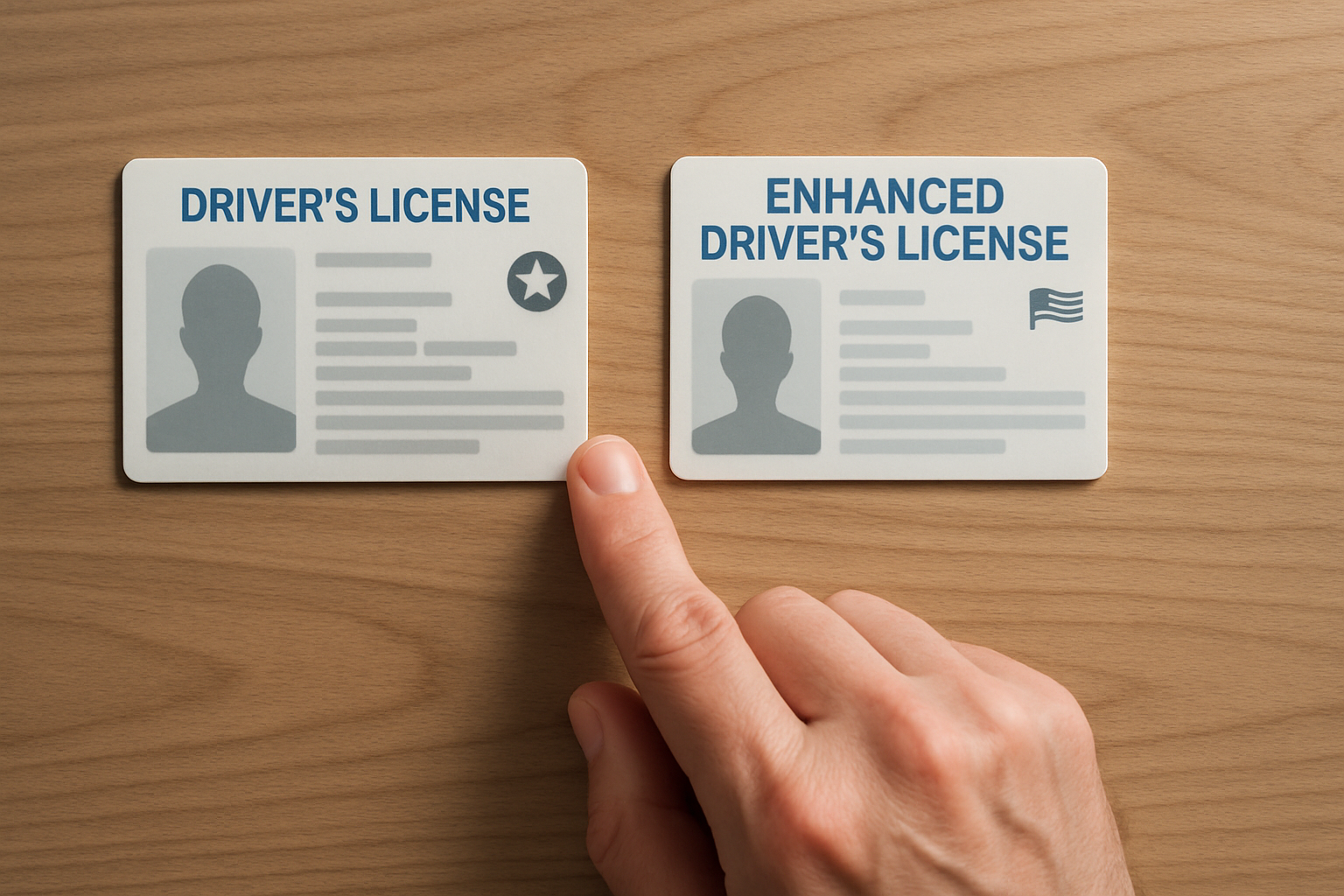
- Gold or black star in the upper right corner → standard REAL ID-compliant license
- U.S. flag icon (sometimes with a wave pattern) + star or “Enhanced” text → Enhanced Driver’s License (REAL ID-compliant + border capable)
- “Federal Limits Apply” or “Not for Federal Identification” → non-compliant; not accepted at TSA checkpoints
If you’re in New York and applied before 2018, check whether your license says “Real ID” or “Enhanced” explicitly — both are available there and look similar.
How border crossings actually work with an EDL
At a land border crossing, the CBP officer will ask you to present your document. With an EDL, the RFID chip is typically read remotely as you approach the booth — your record may appear on the officer’s screen before you even hand over the card. The officer confirms your identity and asks standard entry questions.
The process at major crossings like Windsor/Detroit, Buffalo/Niagara, or Blaine/Vancouver is the same as presenting a passport card. The EDL is accepted at staffed vehicle lanes and pedestrian lanes. It is not accepted at Global Entry kiosks (which require a passport or a Global Entry card) and it does not qualify for the NEXUS lane (which requires a NEXUS card). See Global Entry vs NEXUS if you cross borders frequently and want expedited processing.
For closed-loop cruises departing from a U.S. port, an EDL is accepted as a boarding document in most programs. However, some cruise lines require a passport book regardless of CBP rules — check with your cruise line.
The RFID chip: what you should know
EDLs contain a passive RFID chip that can be read by CBP at up to about 30 feet. The chip contains only a unique identifier number — not your personal data — that links to a CBP record.
Some travelers carry their EDL in an RFID-blocking sleeve when not at the border, though this is a personal choice. The chip does not transmit any information unless it’s within range of a compatible reader. Standard wallet RFID sleeves block it effectively if that’s a concern.
REAL ID-compliant licenses without the EDL designation do not contain RFID chips.
Common pitfalls
- Using an EDL for international air travel. An EDL is not valid for any international flight — not even to Canada or Mexico by air. For any international flight, you need a U.S. passport book.
- Assuming an EDL works at the airport in Canada. An EDL only works at land and sea ports of entry. Flying into Toronto or Vancouver requires a passport.
- Getting an EDL if you’re not a U.S. citizen. Non-citizens are ineligible for EDLs regardless of immigration status. REAL ID is the correct path for lawful permanent residents and visa holders.
- Forgetting the REAL ID requirement in non-EDL states. If you move from Washington (EDL state) to California (non-EDL state), your Washington EDL may work at TSA for a while but eventually you’ll need a California REAL ID or a passport.
- Confusing NEXUS with an EDL. A NEXUS card is a CBP/CBSA trusted-traveler program card that expedites border crossings with Canada. It’s issued by CBP, not a state DMV, and requires a separate application and interview. It’s not the same as an EDL.
What to do next
If you live in Washington, Michigan, Minnesota, New York, or Vermont and you regularly cross the northern or southern border by land, the EDL is worth the modest extra cost over a standard REAL ID. Visit your state DMV with citizenship documentation and you can get both REAL ID compliance and WHTI border access in a single card.
If you don’t live in one of those five states, or if you travel internationally by air at all, a U.S. passport is the more flexible document. The passport card is a wallet-friendly alternative that does everything an EDL does — plus it’s available to residents of all 50 states. Start your passport application and we’ll guide you through the paperwork step by step.
Frequently asked questions
What is an Enhanced Driver’s License (EDL)?
An EDL is a state-issued driver’s license that is both REAL ID-compliant (accepted at TSA checkpoints for domestic flights) and Western Hemisphere Travel Initiative-compliant (accepted at land and sea borders with Canada and Mexico). Five states issue them: Washington, Michigan, Minnesota, New York, and Vermont.
Can I cross into Canada with an EDL instead of a passport?
Yes — by land or sea. An EDL is accepted at land border crossings and closed-loop cruise ports. For international flights to Canada or anywhere else, a U.S. passport book is still required.
Is an EDL the same as a REAL ID for domestic flights?
Yes. An EDL is REAL ID-compliant and fully accepted at every TSA checkpoint for domestic air travel.
How much does an EDL cost compared to a REAL ID?
A standard REAL ID upgrade costs $25–$50 at the DMV. An EDL typically costs $30–$60 in issuing states, reflecting the additional production requirements.
Which five states issue Enhanced Driver’s Licenses?
Washington, Michigan, Minnesota, New York, and Vermont. No other states currently issue EDLs.
Do I need extra documents to get an EDL vs a REAL ID?
Yes. An EDL requires proof of U.S. citizenship specifically — a certified U.S. birth certificate, naturalization certificate, or U.S. passport. A standard REAL ID only requires proof of lawful presence, which includes permanent residents and certain visa holders. Non-citizens cannot obtain an EDL.
Sources: DHS REAL ID overview, CBP Western Hemisphere Travel Initiative, TSA accepted IDs. Fees and state availability verified April 2026.
Need help with your passport application?
We handle the form, photo check, and tracking. Pay only after eligibility is confirmed.
Related reading
REAL ID enforcement is in full effect at every U.S. airport. If your driver's license isn't compliant, here's exactly what flies and what doesn't in 2026.
REAL ID by state: DMV wait times range from same-week to 10+ weeks. See which states are fastest, which are slowest, and what your options are in 2026.
Real ID requirements: proof of identity, SSN, two address proofs, and name-change docs. Bring originals. Here's the full accepted-document list.
Passport card vs book: the card costs less and fits in your wallet, but only works for land and sea travel. Here's which one you actually need in 2026.